We are told masculinity is toxic.
Tell that to Chesty Puller.
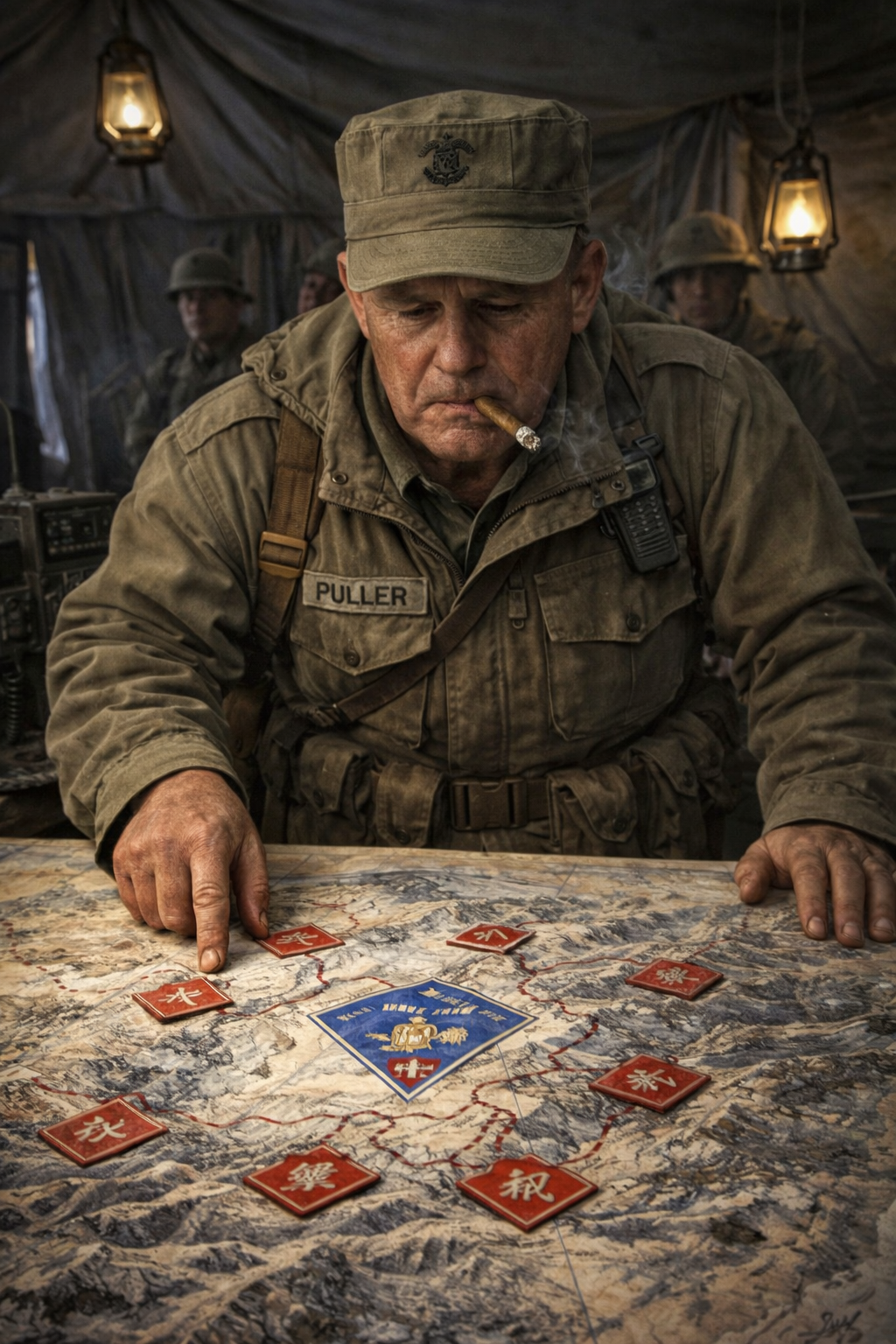
Lewis Burwell ‘Chesty’ Puller was the most decorated Marine in the history of the Corps. He was born in 1898 in West Point, Virginia, and joined the Marines at the end of the First World War. He earned his reputation in the jungles of Central America during the Banana Wars, where Marines hunted insurgents through thick countryside, fighting in close combat, often with little support.
The Pacific War hardened his reputation into that of legend. Puller commanded Marines at Guadalcanal, Cape Gloucester, and Peleliu, holding ground through repeated assaults and steadying his men whenever the line started to bend.
Combat neither excited nor frightened Chesty Puller. It was simply a responsibility he carried for the Marines under his command, and he carried it with discipline, honor, and courage.
At the Chosin Reservoir, during the Korean War, eight Chinese divisions poured down from the mountains and surrounded the First Marine Division. Puller pushed his regiment forward, into the enemy, to keep the division intact. When the Division Commander, General Oliver Smith, was apprised of Puller’s movements, he replied, “Retreat? Hell – we’re just attacking in a different direction.” Puller’s regiment then helped the division fight over seventy miles to the coast.
Temperatures dropped as low as -30 F in what Marines still call ‘The Frozen Chosin.’
The Navy Cross is the second-highest award for valor in the United States, after only the Congressional Medal of Honor. The Navy Cross Puller earned at the Chosin Reservoir was his fifth, and he retired from the Marine Corps in 1955 as a lieutenant general.
Away from the battlefield, Puller was quiet and reserved. Marines saw the hard commander who expected discipline and courage, but when he came home, he was not the most famous Marine in the history of the Corps. He was either Lewis or Dad, spending evenings with his wife, talking with his children, and showing the same loyalty to his family that he demanded from Marines in the field.
Marines trusted Chesty because he shared their danger. His family trusted him because he shared their love.
Puller never chased fame and never tried to polish his reputation. The Marines who served under him remembered that when the fighting started and the ground shook, Chesty moved toward the sound of the guns, carrying his men with him.
I chose Chesty Puller for the intro to this essay, but I could have chosen Thomas Sowell, who was also a Marine during the Korean War before becoming America’s greatest living economist.
I could have chosen Jimmy Stewart, who climbed into a B-24 and flew twenty combat missions over Nazi Germany, earning the Distinguished Flying Cross twice before returning home and becoming one of the most beloved actors in history.
I could have chosen any number of great men.
Audie Murphy became the most decorated American soldier of the Second World War before later appearing on movie screens across the country. Clark Gable was already a major film star when he joined the Army Air Forces and flew combat missions over Europe in B-17 bombers. Charlton Heston served as a radio operator and gunner on B-25 bombers in the Pacific, long before he stood in front of cameras as Moses or Ben-Hur.
George H. W. Bush climbed into a torpedo bomber at nineteen years of age, flew combat in the Pacific, and climbed aboard a burning torpedo bomber on an aircraft carrier’s main deck, risking his life to pull a fellow pilot out of the cockpit while the deck crew pushed the plane overboard. He later, of course, became President of the United States.
When danger came, these men stepped forward to defend our nation and the American way of life. They accepted risk as part of their duty and carried that sense of responsibility with them for the rest of their lives. Were these men masculine? Absolutely. But they were the opposite of toxic.
We are told that men start wars, but power brings war, and women in power have historically wielded it the same way men do.
Catherine II of Russia pushed the Russian Empire south in multiple wars with the Ottoman Turks. She tore Poland apart, splitting it with Austria and Prussia. Elizabeth I of England fought Spain and crushed rebellions in Ireland, while English ships and soldiers spread her empire across the seas. Maria Theresa spent years fighting across Europe in the War of the Austrian Succession and then plunged back into conflict with Prussia during the Seven Years’ War.
Isabella I of Castile finished the Reconquista by conquering Granada and ending Muslim rule in Spain. Empress Wu Zetian expanded Chinese power through campaigns into Korea and Central Asia. Queen Ranavalona I fought European powers to hold Madagascar under her rule.
Armies march no matter what gender is in charge.
By extension, there have been a large number of weak men in power.
James Buchanan watched the Union fracture and treated it as a problem to be managed rather than a crisis to confront. He insisted he lacked the authority to act while states prepared to leave. By the time stronger leadership arrived, the lines had hardened and war was unavoidable. His restraint did not preserve peace. It allowed the situation to deteriorate beyond recovery.
Tsar Nicholas II held absolute power and exercised it poorly. He wavered between repression and concession, satisfying no one and stabilizing nothing. As Russia collapsed under the strain of war, he drifted further from reality. Authority without resolve does not hold a state together. It accelerates its collapse, leading to a disastrous experiment with communism in the Soviet Union.
Jimmy Carter failed to support the Shah of Iran, leading to the rise of the Islamic Republic of Iran. When students, led by the Ayatollah Khomeini, captured the American embassy, the Iranian hostage crisis dragged on for 444 days. The failed rescue attempt reinforced the image of American weakness that had been forged in Vietnam.
Carter should have kept the Shah in power, while ensuring that the Shah understood that he needed to provide his people more political freedom by starting to transition to a Constitutional monarchy.
Adversaries do not need overwhelming strength. They need to believe there will be no response. Once that belief takes hold, pressure follows. Boundaries are tested, then crossed. Only when they meet resistance do they stop.
Masculinity is blamed for violence, but it is disciplined strength that prevents it, and disciplined strength prevents war regardless of the gender wielding it.
The same traits that make men capable of war are the traits that deter it. Remove those traits, or teach men to distrust them, and you do not get peace. You get instability waiting for someone stronger to exploit it.
Toxic Masculinity
I usually start contentious pieces with definitions, but in this case if I define ‘masculinity’ precisely, I invite debate over the definition, and this is about more than semantics.
Masculinity includes strength and aggression, and of course those things can be toxic, but this is precisely why these traits need to be controlled rather than suppressed. Masculinity becomes toxic when it is mixed with isolation, meaninglessness, breakdown of family structure, or loss of responsibility. Toxic masculinity is masculinity when immature.
‘Toxic’ means ‘poisonous or contaminated.’ Something toxic is dangerous by nature, and when we say the natural tendencies inherent to masculinity are ‘toxic,’ we do a great deal of harm to adolescent boys. This recasts the traits that build soldiers, sailors, explorers, and fathers, into social hazards to eliminate.
For proof that masculinity is toxic, we are told that the vast majority of violent criminals are male, as are the vast majority of mass shooters.
That’s actually true. Men commit the vast majority of violent crime, but what does that fact really tell us?
There are differences between genders in a number of traits.
Men measure higher on aggression whereas women measure higher on agreeableness. The differences are trivial in the middle of the bell curve, but violent criminals are outliers, and because men score higher on aggression, most of the outliers are, of course, men.
So are most of the heroes, and for the same reason.
There are other differences. Men and women have the same average intelligence levels, but the bell curve for men is wider than for women such that most of the world’s geniuses, and idiots, are men.
Until very recently, we lived in a world ripe with ways to kill us. Life was frequently dangerous, and short. The notion that men oppressed women was simply not true; men and women worked together to protect their families and to survive.
Men built the cities, worked the fields, and fought the wars. Women faced different dangers. Pregnancy slowed movement and drained strength, and dying during childbirth was not uncommon. A mother with an infant could not run for miles, swing an axe all day, or march into a fight.
The simple truth is that one man can impregnate multiple women but can bear no children. Societies need children to survive, so biology made men expendable, and we evolved around that fact. This affected not only biology, but culture, such that on the Titanic it was women and children first.
The modern world is different. We live in climate-controlled houses. Power tools, hydraulics, robotics, and other forms of automation have replaced most back-breaking labor. Women today are just as capable as men in most fields, and, perhaps more importantly, women have every right to pursue whatever careers they want.
Women have been in the workforce in large numbers for over 50 years.
Perhaps over time, men and women will evolve to be more alike, but you cannot erase millions of years of evolution in a single lifetime. Nor is masculinity toxic. Aggression, for example, is fuel.
Aggression sits in the body the same way heat sits in a furnace. Power waits for an outlet and then explodes. Suppressing aggression does not make it go away – it either finds a positive outlet, or it finds a negative one.
For most of human history, men understood this, and they built structures to discipline their natural aggression.
Warrior codes demanded restraint, honor systems punished both cowardice and cruelty. Brotherhoods bound men to one another so that strength served the group instead of the ego, and fathers handed discipline down to sons.
Competitive sports also channel aggression into something positive. Sports took male volatility and forced it through discipline. The wild edge stayed sharp, but it did not cut everything around it. Competitive sports used to be considered so important in guiding boys into men that military academies used to require students to participate in at least one.
That discipline shows up both on and off the field. Men who learn to control aggression become reliable under pressure. When something breaks, controlled aggression turns chaos into action.
A man who has learned to master himself can focus, endure, and finish what he starts. He can carry weight without complaint, solve problems without panic, and keep going when others quit.
People don’t follow the loudest man in the room or the most emotional, but the one who does not lose control when things get tough. Discipline makes strength predictable, and predictable strength is something others can rely on. The same traits that can cause harm when left unchecked become the traits that protect others.
People follow strength, whether it comes from someone like Chesty Puller, Bob Dole, or Margaret Thatcher. It’s not about gender. It’s about leadership, and women should want men who are competent.
A controlled man does not look for fights, but he does not run from them either. He stands between danger and the people who cannot stand for themselves. A weak man retreats and becomes a coward when a strong man challenges him. Men being physically stronger than women, this makes weak men poor partners.
Discipline builds restraint. A man who knows he can act chooses when to do so and when not to. Discipline also builds brotherhood. Men who are tested together form bonds that endure. When Steven Spielberg and Tom Hanks made a miniseries about paratroopers in WWII, they did not call it ‘Men Who Fight.’ They called it ‘Band of Brothers.’
When I was in the 82nd Engineer Battalion, in Bamberg Germany, I felt the same thing. My platoon mates were not just coworkers. We lived and suffered together, and being overseas in a nation that spoke another language, we really were like brothers. Was I a man before I joined the military? I don’t know, but I certainly was eight years later, when I got out.
To this day I believe in chivalry. I open the door for my wife and carry things for her, not out of dominance, but out of respect. I would not only die for my wife, but would, if necessary, kill for her.
Her life is more important than mine.
No one marked the moment masculinity became ‘toxic,’ but as the idea of ‘toxic masculinity’ grew, the ideals that had previously guided and shaped men started to disappear.
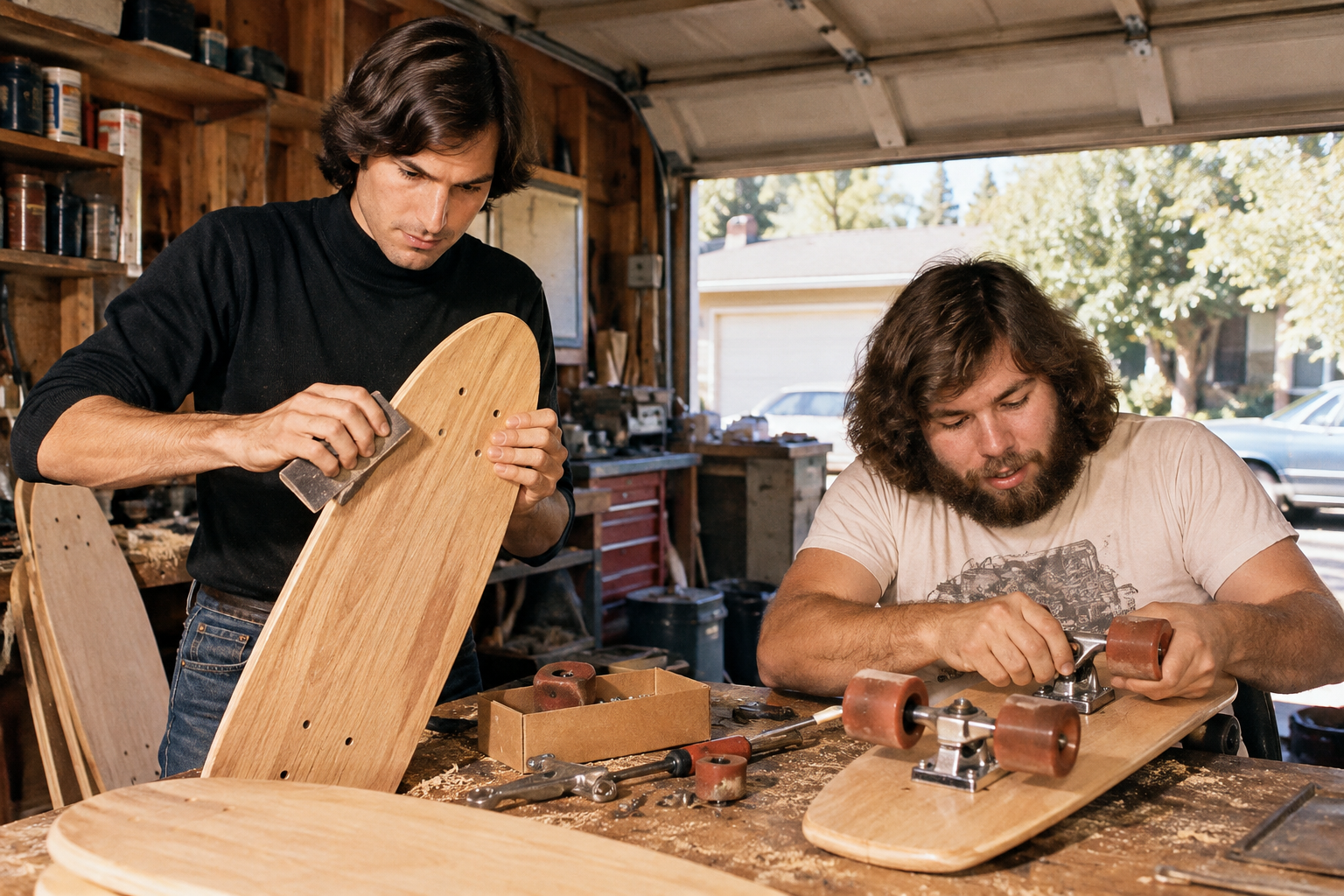
Boys spent more time in classrooms and less time in garages, on job sites, or in fields. They still had energy and the urge to compete, and they still wanted to test themselves, but they were told that their natural instincts were a fault they needed to learn to suppress.
Evolution and Control
I was a divorced father living in a small apartment when I got a German Shorthaired Pointer named Cody. GSPs are loyal, affectionate dogs. They are often called ‘velcro dogs,’ but they are also hyper, and if they do not get enough exercise they can become destructive.
Cody chewed up a couch, a lazyboy, a number of blankets, and about a half dozen shoes. He would try to sneak out whenever someone opened a door, and would run (usually chasing deer) for hours before trotting home.
I once had a friend babysit Cody. She watched him for a week. Afterwards she told me she wanted to get a dog, but was going to research breeds to make sure the dog she got would be nothing like Cody. She loved his intelligence and affection, but she could not handle the energy.
Cody calmed down quite a bit once I remarried and bought a house with a big enough yard for him to run in. My wife and I now have a GSP named Sherlock. Sherlock is bigger and faster than Cody was, but Sherlock is a gentleman who gets all the exercise he needs.
What we don’t have is grass in our backyard. Sherlock runs so much it’s almost all dirt.
When I suppressed Cody’s natural instincts by confining him to a small apartment, he spent his energy in destructive ways. The same is true of people. Suppress natural instincts and they do not go away. They become destructive. Young men suppressing their masculinity still have the strength and aggression of other boys. What they lack is control.
Competence must come before authority. A man given authority without earning it does not understand its weight, and he will use it poorly. Boys who are never given responsibility do not become men who seek it. They learn to delay, defer, and avoid. When responsibility finally arrives, it crushes them. A lack of responsibility leads to a lack of meaning, and people who lack meaning are not emotionally stable. This does not just impact the individual. Individual problems will always exist. Some people have mental health issues, and some are just broken. When a lack or responsibility scales upward, though, it impacts the entire civilization it is a part of.
Status must be earned. Hand it out and it means nothing. Earn it, and it creates standards men rise to. Failure must have consequences. Without consequences, there is no feedback, and without feedback, there is no growth.
A man who never pays for his mistakes never learns from them.
Back in my day, boys did not hit girls, and on the rare occasions when a boy did hit a girl, another, generally bigger boy, beat the hell out of him. And it wasn’t just women – the vulnerable were often protected by the strong. That has always been one of the defining responsibilities of men. Strength exists, in part, to stand up for those who cannot defend themselves.
I was a bit of a wimp when I was young, and it was another boy standing up for me (thank you Lloyd!) that embarrassed me enough to get me to toughen myself up. For a decade or so I went the other way and started fights whenever someone tried to intimidate me. Strength with wisdom is somewhere in the middle, but even without wisdom, it is better to fight a bully than to back down.
None of this is new. These are the same principles that have shaped men for millennia. What is new is the idea that those principles are somehow harmful.
They are not.
You do not reduce danger by attacking masculinity. You reduce danger by maturing it. Calling masculinity toxic does not solve the problem. It only makes it worse.
Masculinity is the mechanism through which male traits are shaped and directed. When you label that mechanism as harmful, you do not eliminate the traits. You remove the structure that gives them purpose. Boys must not only be allowed to become men – they must actually become men. A world full of adult boys would not be a very pleasant place to live.
Lewis Burwell “Chesty” Puller did not lack aggression or strength. He mastered and directed them. The same was true of Jimmy Stewart, Audie Murphy, Bob Dole, and millions upon millions of other men.
Slavery did not end in this world because women decided it should, but because men killed other men to force the practice to end. Every evil ended through war is ended by men.
The same traits that produce the most dangerous men also produce the men a society depends on to survive. The difference is not the traits, but how they are used.
And we don’t call it ‘masculine’ when it is weak. We call it that only when those traits are used with discipline and honor. We call it ‘masculine’ when we act like Chesty Puller and move toward danger rather than away from it.
Our society does not struggle because it has too much masculinity.
It struggles because it has too little.