My first presidential election was in 1992. My friends and I, young idealists who thought George H. W. Bush was too much of a Washington insider and too little like Ronald Reagan, voted for H. Ross Perot. We siphoned off 12 percent of the vote and helped put William Jefferson Clinton in the White House.
Bill Clinton turned out to be conservative, for a Democrat.
Clinton embraced market economics, free trade, and fiscal restraint. He pushed NAFTA through despite fierce opposition from organized labor and signed welfare reform imposing work requirements and time limits, declaring he would “end welfare as we know it.”
Clinton expanded policing and strengthened sentencing standards. He supported financial deregulation, including the repeal of Glass-Steagall, and presided over balanced budgets and deficit reduction.
In 1996, Clinton stated that “the era of big government is over.”
Even on immigration, the Clinton administration emphasized enforcement and the rule of law, expanding deportations and strengthening border controls.
Contrast that with the man who made me a conservative: Ronald Reagan.
Reagan was conservative in temperament and rhetoric, but his conservatism rested on classical liberalism. He championed free trade and global market integration, signed immigration reform that included amnesty, upheld multilateral alliances such as NATO, and spoke of American exceptionalism in civic terms.
His economic program reduced tax rates and regulation, but it did not pursue state-directed industrial policy or protectionist tariffs. Even at the height of the Cold War, Reagan articulated a vision of liberty grounded in individual rights and constitutional order. Though he remains a conservative icon, he operated within a liberal-democratic framework that treated globalization, civic nationalism, and procedural neutrality as givens.
Today, segments of the Republican Party question free markets, retreat from multilateralism, accept state-directed economic coordination, and lean into grievance-based politics.
For most of the late twentieth century, both parties accepted the same premises: market capitalism, civic nationalism, constitutional liberalism, global engagement, and equality under the law. They offered different routes but moved in the same direction.
The parties remain institutionally intact, but neither resembles what it was when I began voting. What appears to be chaos, however, is not collapse so much as recomposition.
The organs of the body politic still function, but they are pulling apart, carrying the country with them.
My first vote was for Ross Perot, but the first election I remember was Carter and Ford. I was five, sitting in my parents’ bedroom while they watched the news. I looked at the two men and said, “I like Ford.” My dad asked why. “Because he has hair,” I answered. My mom corrected me. Carter had hair. I switched immediately. “Oh. Well I like Carter then.”
My father launched into a rant about how people vote based on appearance and how that helped put John F. Kennedy in office.
I voted for Jimmy Carter in an elementary school mock election. Carter won the school but lost the country to Reagan. From Reagan through the 2008 campaign, both parties operated within a liberal-democratic consensus.
Obama ran as a moderate in 2008, but in his inaugural address he promised “radical transformation.” Though he did not fully deliver on that promise, he did change the nature of both parties.
Earlier Democrats combined organized labor, industrial workers, civil rights constituencies, and institutional moderates. Earlier Republicans unified neoconservative foreign policy leadership, Christian conservatives, free-market globalists, and constitutional or libertarian thinkers.
They fought over regulation levels, tax rates, welfare policy, and cultural norms. They did not fight over whether the economy should rest on market capitalism. Nationalism was not labeled “fascist,” and Enlightenment assumptions about truth and law still carried public authority.
Even Clinton’s 1992 campaign, often remembered as progressive, ran on fiscal restraint, trade expansion, welfare reform, and global integration. One of his slogans was “Make America Great Again.” Both parties treated globalization as an engine of prosperity while recognizing the nation-state as the primary political unit.
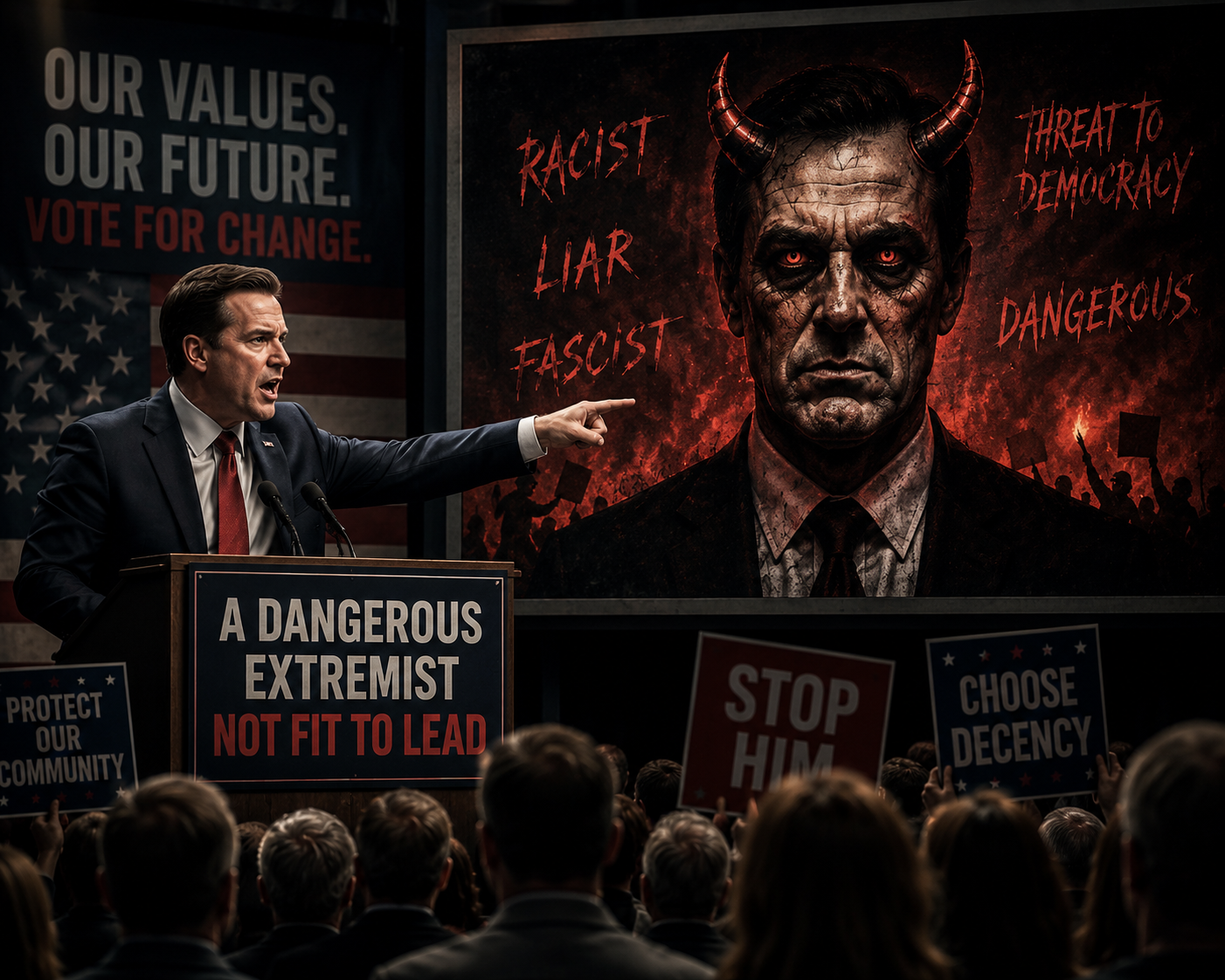
That shared direction no longer holds. As the parties pulled apart, attacks turned personal. They no longer simply disagree. They increasingly hate one another.
The country has known division before, but such division has never strengthened us.
Three forces unsettled the late twentieth century equilibrium.
The first was an economic realignment. Globalization hollowed out industrial regions, wages stagnated for non-college workers, and the managerial class in large cities expanded.
Second came institutional consolidation. Media ownership concentrated, the administrative state expanded. Universities and NGOs gained cultural authority and corporations and regulators overlapped, blurring public and private power.
Third came shifts in sovereignty and integration. Multilateral institutions rose in prominence, and policy increasingly coordinated through transnational frameworks.
The Democratic Transformation
The Democratic Party is no longer the labor-populist machine of the late twentieth century. It still speaks the language of unions and still takes union money, but its center of gravity has shifted. The working class is no longer its organizing core.
Its base is now disproportionately college educated. Influence concentrates among professionals in academia, media, the permanent bureaucracy, nonprofit leadership, regulatory agencies, and corporate management. The party increasingly reflects the worldview of a technocratic moral and intellectual elite that believes only it possesses the knowledge required to govern. Those who disagree are increasingly dismissed outright.
That mindset surfaced during Covid, when talk of a “Great Reset” moved from fringe slogan to open aspiration, with pandemic controls discussed as foundations for permanent redesign, be it for a climate emergency or another declared crisis.
The Great Reset was never formal party doctrine, but it did not need to be. Its assumptions filtered into policy conversations that many Democrats endorsed. Much of the media echoed them.
Legislative compromise yields to executive rulemaking when Democrats govern. Regulatory coordination expands. Policy flows through administrative channels rather than Congress, and authority consolidates inside credentialed networks that prize expertise, procedural control, and institutional alignment.
Out of power, Democrats increasingly treat the other side as illegitimate, not merely wrong.
At the same time, the party has drifted from civic nationalism toward globalism. It frames immigration expansion as a moral duty and an economic necessity. Under the Biden administration, as much as $195 billion per year, according to Elon Musk’s DOGE disclosures, moved through USAID into NGOs that facilitated large-scale migration into the United States.
The party has embraced collectivism, though it is divided over which version to pursue. One faction leans toward Marxism. Another follows what I call ‘economic fascism.’
“Fascism” is often used as a slur. Here I use it as a structural term rooted in the philosophy of Giovanni Gentile, who coined it, just as Marxism traces to Karl Marx.
Fascism, like communism, contains political and economic components. Politically, it is hyper-nationalist and totalitarian, casting a dictator as the “living embodiment of the people” and subordinating the individual to the state.
Democrats reject that political structure. Fascism, however, also includes an economic system.
When Democrats call themselves “Democratic Socialists,” they detach Marxism’s economic model from its authoritarian political form and overlay it with a different political system. The same structural separation applies to fascism. One can adopt Gentile’s economic structure under a different political shell. That is what I mean by economic fascism.
Fascism permits private enterprise so long as it advances the state’s central plan. Ownership remains nominally private but operates under state control. Pay and profit reward compliance with national objectives. The firm exists, but does not rule. The state does. Firms comply or lose control, as when President Obama removed the CEO of General Motors.
China offers a modern hybrid. Corporations operate in markets but, in the Chinese model, they remain instruments of the state, with the government holding ownership stakes and decisive control over major firms. Many on the Western left, including Mark Carney, have spoken favorably of this model, despite China’s openly authoritarian political structure.
These systems share a core. They centralize economic direction and subordinate production to state priorities. Because labor is a big part of the means of production, this subordinates the individual to the collective, even when the collective expands beyond the nation-state.
Technocratic elitism depends on institutional stability. It seeks cohesion and managed continuity. The activist wing, however, thrives on disruption and moral confrontation.
Together, activists destabilize opposition institutions while technocrats consolidate authority whenever power is secured. Though the party’s most energetic voices speak in Marxist terms, durable authority rests with the technocrats.
The modern Democratic Party is technocratic, globalist, and collectivist. It no longer defends the classical liberalism on which the nation was built, and grows increasingly intolerant.
The Republican Transformation
The Republican Party did not stand still while Democrats changed. It too reorganized.
For decades, it ran on a trifecta. Neoconservative interventionists set foreign policy. Christian conservatives shaped moral language. Free-market globalists wrote economic doctrine. These groups had little direct overlap, so they formed a durable coalition that shaped party leadership. As a result, trade liberalization, deregulation, Christian morality, and an assertive posture abroad formed the base.
The Trump era did not create dissatisfaction inside the party. The Tea Party did – directed first toward Obama and the Affordable Care Act, and later toward what the Tea Party called ‘RINOs,’ which stands for Republicans In Name Only.
Trump gathered that dissatisfaction, named it, and weaponized it.
Non-college voters, especially in declining industrial states and rural regions, had already felt the ground shifting beneath them. They moved into the new Republican base.
Economic displacement collided with cultural marginalization. Both filtered through deep distrust of elites. Trade skepticism replaced free trade as an article of faith. Economic nationalism displaced global markets. Globalization began to sound like a sermon preached to people who had already lost their jobs, and Republican economic policy now reflects that shift.
On key economic questions, much of today’s Republican coalition now sits to the left of Bill Clinton’s 1992 platform. Tariffs are no longer taboo. Industrial policy is no longer a dirty phrase. Supply chains are treated as national security assets. State coordination is discussed openly. In the 1990s, none of this would have survived a Republican primary. Today it draws applause.
The cultural register shifted as well. The Christian conservative movement has taken a back seat. Grievance-based rhetoric has grown sharper. Identity language, once confined to the left, now appears in conservative circles, framed not around minority status but cultural displacement.
The right and the alt-right are often conflated, but they are distinct.
Classical conservatism rests on civic universalism. It treats the American project as constitutional and cultural and rejects identity politics. Historically, conservatives focused on negative rights and general principles rather than targeted policies for specific groups.
The alt-right rejects that foundation. It grounds political identity in race and hierarchy. It treats demographic composition as destiny and argues that culture flows from blood.
The alt-right embodies the caricature the left long projected onto conservatism.
There is rhetorical overlap between alt-right voices and Republican populists around demographic anxiety and civilizational decline. The language can sound similar. The foundation is not.
The alt-right began on the fringe, but figures such as Candace Owens and Tucker Carlson have echoed elements of its rhetoric and given it oxygen. That carries risk. If the Republican Party becomes the Democratic Party inverted on race, no major party will defend classical liberalism, and the American experiment will fail.
As populism rises, the party’s center weakens. Neoconservative foreign policy recedes. Free markets no longer dominate. Libertarian voices remain, but they compete with nationalist ones, and the old guard no longer commands; it bargains.
The move away from blind faith in global free markets makes sense when adversaries and trading partners weaponize those markets against us, but abandoning markets altogether would be a mistake. The party must defend free enterprise, particularly within its borders, and must use free markets globally, at least with the trading partners we trust. Republicans must uphold Judeo-Christian moral norms as the cultural engine of our country, while defending equality under the law and individual liberty.
Today’s Republican Party includes old-school Democrats alienated by the modern left, along with traditional conservatives, constitutional conservatives, and libertarians. It remains deeply patriotic but less focused on limited government and free markets.
The right has become a large tent of competing interests. It spends more time attacking the left than articulating a coherent vision of America’s future. This is not because Republicans lack ideas, but because this coalition, that once spanned both parties, lacks broad agreement.
The political right must reject the alt-right outright. If Republicans chase those votes, the country loses.
The Hollowing of the Middle
There was a time when the parties still spoke a common language. They argued over tax rates and spending levels. They fought over the size of government and the pace of reform, and clashed over welfare policy, defense budgets, and cultural norms. They did not fight over the meaning or purpose of the country.
Both parties operated inside a liberal-democratic framework that assumed the legitimacy of the Constitution, the primacy of the nation-state, the value of markets, and the equality of citizens under the law. Elections decided policy direction, not the identity of the regime. Courts interpreted law; they were not treated as partisan actors. The press criticized power but was not broadly viewed as an enemy of the state, and though disputes were sharp, the architecture was shared.
That common ground is gone.
The Democratic Party now pushes managed global integration and rule by credentialed elites. It treats borders as negotiable, speech as regulable, and equality as something to be engineered rather than protected. Institutions are not neutral referees but mechanisms for producing approved social outcomes. Expertise is elevated above consent, and administrative authority expands as legislative compromise recedes.
The Republican Party now pushes national sovereignty and economic intervention on behalf of our citizenry, and wants to deport masses of illegal immigrants. It questions trade deals, foreign entanglements, central banking authority, and the moral legitimacy of the press, the academy, and large segments of the federal bureaucracy. It once defined itself by limited government. Much of it still claims that inheritance, yet it now embraces intervention when it believes that markets or institutions have weakened the country’s industrial base, cultural cohesion, or border security.
On the left, neutrality is treated as complicity. Equity replaces equality as the governing principle and outcomes override rules. Disparate results are presumed evidence of injustice, and institutions are expected to correct them.
On the right, those same institutions are no longer trusted to apply rules honestly. Courts are viewed through partisan lenses and federal agencies are suspected of ideological enforcement. Media outlets are assumed to curate narratives rather than report events. The language of “weaponization” has entered mainstream political speech.
The right still believes in the rule of law. The problem is not rules. The problem is trust. Many conservatives no longer trust the individuals and institutions empowered to interpret and enforce those rules.
Elections are no longer routine contests between competing policy visions. They are framed as existential struggles. Republicans suspect ballot manipulation, administrative bias, and procedural asymmetry. Democrats suspect voter suppression, structural obstruction, and anti-democratic intent. Each side assumes bad faith in the other. That assumption reshapes behavior.
Primary systems reward the loudest voice and the sharpest attack. Candidates fear their base more than their opposition, and moderation is treated as weakness.
Cable panels and social-media feeds amplify outrage as outrage spreads faster than nuance. District maps insulate incumbents from cross-party accountability, making ideological purity more valuable than coalition-building. The middle shrinks because there is no political reward for standing in it.
Political rhetoric follows incentives. When compromise carries risk and confrontation carries reward, confrontation becomes strategy. Language hardens, motives are impugned, and disagreement becomes accusation.
When a country loses shared assumptions about law, legitimacy, purpose, and national identity, it becomes unstable. Every major vote becomes a test of survival, and every loss is interpreted as permanent damage. Victory is treated as temporary and reversible while defeat is treated as catastrophic.
In that climate, politics ceases to be a contest over policy. It becomes a contest over control. Institutions are no longer arenas for debate but battlegrounds for dominance.
That is not ordinary partisan rivalry.
It is structural decay.
A System Under Tension
The American system works best when Democrats identify problems and force Republicans to confront them, and when Republicans force Democrats to negotiate solutions within established constitutional limits. Pressure moves in both directions, but that balance no longer holds.
Power on the left concentrates in agencies, courts, universities, foundations, and global forums. It trusts credentials and follows those who promise fairness through regulation and control. The state is treated as an instrument for shaping outcomes rather than protecting rights. Climate, equity, and global responsibility are framed as settled truths, not open debates, and the question is no longer whether government should expand, but how quickly and how comprehensively.
Power on the right gathers around flags, factories, sheriffs, and churches. It speaks of sovereignty, border walls, industrial revival, and cultural cohesion. It questions trade agreements, central banks, intelligence agencies, and federal departments insulated from electoral accountability, and it is willing to use tariffs, subsidies, and state leverage to defend domestic industry. It no longer defers automatically to free-market doctrine when that doctrine appears to empty towns and erode the middle class, and it no longer trusts those in government to act as neutral stewards.
One side believes authority should flow outward from expertise, even when it crosses borders and bypasses national consent. The other believes authority must flow inward from the nation, even when that choice imposes economic cost or international friction. One leans toward global governance and harmonized standards. The other leans toward national control backed by economic muscle and cultural assertion.
A country cannot steer in both directions at once.
On the left, neutrality is rejected when it obstructs preferred outcomes. On the right, institutions are rejected when they produce unwanted results. Each side claims to defend democracy while questioning the legitimacy of the other side and trust drains from the center.
When trust erodes, politics changes character. It stops functioning as a debate over policy details and becomes a struggle over control. Administrative authority expands to bypass legislative stalemate, executive orders replace negotiation, courts become arenas for political objectives, and elections are framed not as routine transfers of power but as existential battles for survival.
In that environment, compromise feels like surrender.
I was five years old when I switched my vote from Ford to Carter because I thought the wrong man had hair. My father lectured me about how easily voters are swayed by image. He believed he was teaching me about superficial judgment. What he was teaching me, though, was that politics rests as much on perception as on principle.
For decades, the principles beneath the perception were shared. Candidates like Reagan, and later Clinton fought fiercely, but they fought inside the same constitutional and economic frame. The dispute was over emphasis, scale, and implementation, not over the underlying architecture.
That frame no longer governs our politics.
The organs of the body politic still function. Elections occur and courts issue rulings. But the shared assumptions that once stabilized those institutions have fractured. Legitimacy appears conditional to both sides. Where authority is contested, good faith is presumed absent.
If a common foundation of truth and constitutional loyalty is not recovered, the tension will escalate. Polarization will not plateau. It will intensify, forcing institutional conflicts to harden. Street conflict will follow.
Lincoln warned that a house divided against itself cannot stand. He did not mean it would wobble. He meant it would fall.
Division is not new in American history. What is new is the erosion of a shared framework within which division could be managed.
If that framework is not rebuilt, the choice will not be between left and right. It will be between order and fracture. Fracture leads to conflict.
And conflict can lead to war.