

My neighbor’s oldest son Colin decided to start mowing lawns for money a few years ago. He walked around knocking on doors and asking people if he could mow their lawn for $30 a pop. The going rate for landscaping companies was $50, so Colin did not have to knock on very many doors before he had as many lawns as he wanted to mow, which was about two a day, or fourteen per week. He used his father’s lawnmower so his only expense was gas, which was negligible, and he started pulling in $420 a week.
It did not take long before Colin’s younger brother, Aaron, was also mowing lawns. Eventually the boys bought a second lawnmower, and the second year they had a couple of friends following them around with a weed eater and leaf blower. At their peak they were mowing 50 lawns a week and raking in $1,500 in revenue, minus the cost of equipment, gasoline, and whatever they paid their friends.
We live in Michigan, so nobody thought twice about a group of kids mowing lawns for a little extra money, but imagine we were in California and a neighbor reported them to the city.
Some of the neighbors whose lawns they mowed were too old to mow their own lawns, so the city might have asked if charging them was in fact exploiting older people and the disabled, whose lawns perhaps should have been mown at a lower price, if not for free. There is also the cost to actual landscaping companies, who could have charged the same people $50 a lawn and were being undercut by $20. These teenage boys were costing adult lawncare experts their jobs.
The city could have brought up safety concerns. Are teenage children old enough to operate a lawn mower safely? What if they kick up a rock and injure someone or break something? Do they have insurance? Should their business need a license? Should the boys be paying taxes and fees on their income?
How about the possible racial implications of letting kids in a mostly white neighborhood mow lawns for money? What about children living in the inner city? What about children who live in apartments?
Most people would agree that a few boys making a few dollars mowing lawns is not a bad thing, and that the questions I’m asking are silly in this context, but it is not hard to imagine a city in a state like California asking those questions. It is also not hard to imagine a real landscaping business starting with two brothers mowing lawns. I would, in fact, be surprised if this is not exactly how some landscaping companies were founded.
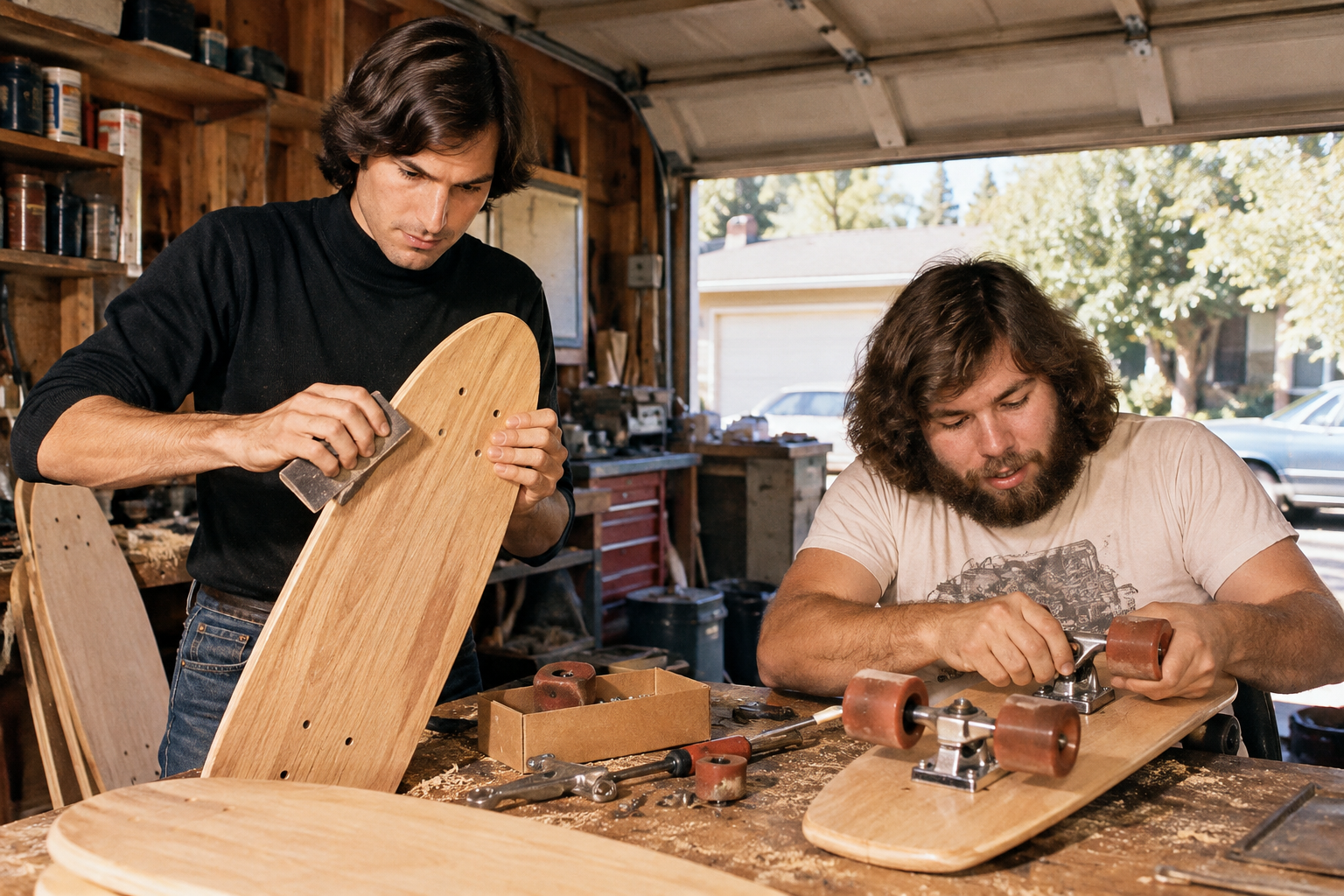
Colin and Aaron were reasonably successful, but what if their business had scaled more? What if instead of mowing lawns, they designed a new style of skateboard and assembled it by hand in their fathers’ garage, selling it first to area skateboarders and eventually to skateboard shops? What if it went global? This is, in fact, how Steve Jobs and Steve Wozniak founded Apple, albeit with computers instead of skateboards, and Apple went on to become one of the largest corporations on Earth.
According to Forbes, Steve Jobs was worth $12.4 billion dollars when he died (adjusted for inflation). He did that by continuing to build computers and then by leveraging the money from building computers to build other things he personally invented, such as the iPhone.
I’m underselling him. Apple fired Steve Jobs in 1985, after the Macintosh failed to live up to expectations due to cost overruns. He responded by forming the NeXT computer company, and then bought the graphics section of Lucas Films to found Pixar. People forget the NeXT computer, but its operating system was a work of art, and even without Jobs at the helm, Apple bought NeXT for that operating system in 1996 for $400 million. By the end of 1997, Apple brought Steve Jobs back as CEO, and the companies Steve Jobs formed now employ over 166,000 people.
Pixar needs no introduction. It produces children’s films, like Toy Story, and it makes money hand over fist.
Many today do not think we should even have billionaires, but did Steve Jobs do anything we should have stopped him from doing, or do people hate billionaires just because of their wealth? And why do we not see the same kind of hate for billionaires who come out of sports or entertainment? I don’t see the same level of hatred applied to LeBron James or Oprah Winfrey.
Walmart is owned by the billionaire children of Sam Walton. Walmart employs over two million people. How many people does LeBron James employ?
Should we have barred Elon Musk from becoming a billionaire? He could have retired after PayPal, foregoing Tesla, SpaceX, Starlink, and everything else Elon Musk has done since. Now he has a car that can park upside down, fly, go from zero to sixty in under a second, and drive 360 miles per hour. Perhaps the world would be a better place if Elon Musk had less money and the companies he formed did not exist.
Should we have barred Steve Jobs from making a billion dollars? He became a billionaire in 1995 when Pixar went public. If we could go back in time and stop him from becoming a billionaire, it would cost us the iPod, the iPad, the iPhone, the smart watch, and a number of other products. One might note that as soon as Steve Jobs died, Apple stopped inventing things. Would the world be a better place without those products?
The first billionaire was John D. Rockefeller, in 1919, back when a billion dollars represented a lot more money than it does today. Measured as a percent of GDP, that puts him on par with Elon Musk. John D. Rockefeller did not steal his money. He made gasoline and other derivatives of oil at less cost than anyone else could match, and then kept improving his operations to stay ahead of the competition. Should we have barred John D. Rockefeller from making driving affordable for the masses, or for making it far cheaper to ship goods to market?
It is easy to imagine a world without billionaires. It would also be a world without Apple, Microsoft, Google, Amazon, Facebook, Walmart, Disney, Oracle, Nvidia, Tesla, SpaceX, Dell, Netflix, Bloomberg, FedEx, Home Depot, Nike, Salesforce, and a host of other companies. All of these companies made their owners billionaires, and all of them would be very different companies today had their owners hit a magic wealth limit and stopped trying to do more. Perhaps we should go back before there were billionaires and stop excessive wealth altogether.
Let’s talk about people who were the equivalent of billionaires in their day.
In 1769, James Watt patented improvements to the steam engine that made it commercially viable for factories and industrial machinery. Without the financial incentives that encouraged Watt and his business partner Matthew Boulton to develop and commercialize the technology, the Industrial Revolution might never have started, or might have started much later. Factories would have remained dependent on waterpower, and the mass production of clothing, machinery, and other manufactured goods would have happened much later, if at all.
Andrew Carnegie helped make steel inexpensive enough for widespread use. Without the investments Carnegie and other industrialists made in steel production, the development of skyscrapers, steel bridges, modern railroads, industrial machinery, and the infrastructure of modern cities might have been delayed by decades, if those things happened at all.
Thomas Edison built businesses around electric lighting, sound recording, motion pictures, and electrical distribution. Without the investments made by Edison and his competitors, electric light bulbs, electrical distribution systems, phonographs, recorded music, and motion-picture technology might have remained expensive curiosities. Homes and businesses would have continued relying on gas lamps, candles, and older mechanical technologies – perhaps even to this day. As I write this, I’m also listening to Joan Baez, Diamonds and Rust. I would not even have a record player had it not been for Edison.
Yes – I collect vinyl…
I could go back further and include the airplane. If I include other countries I can also include the automobile. Without the work of those who invented things so that they could sell them and become wealthy we would spend our lives cold, dark, and hungry. We are all truly equal only when we are dead, so perhaps we should have some gratitude for those who made our lives better, whether they profited or not. The list of people who created valuable things and then became wealthy is long, and though someone would still have an incentive to invent something even if we capped wealth, once they hit the limit that incentive would be gone.
100 years ago, most people still rode horses. 100 years before that, most people had dirt floors and cooked in a fireplace that also heated their home. If we go back much further, we start measuring progress not in years or decades, but in thousands of years. Were people better off in those earlier times?
We are not better off today because we live in a better world. We are better off only because we live after a great many people invented a great many things that make this world vastly easier to survive in. Those who take pot shots at those people for having become wealthy do so while standing, in relative abundance, on their shoulders.
Economist Thomas Malthus wrote in 1798, “It is probable, that the food of Great Britain is divided in as great plenty to the inhabitants, at the present period, as it was two thousand, three thousand, or four thousand years ago.” His language is a bit labored by today’s standards, but you get the point: the British of his time had no more material abundance in 1798 than their ancestors had when still living in a province of Rome, and England at that time was the wealthiest nation on Earth.
Something radically changed, ironically right around the time Malthus wrote that, and this change caused progress to radically accelerate. Adam Smith said it was the free market, and though some might disagree, I can tell you with absolute certainty that the magical change that led to relative abundance was not a wealth cap. When we consider having a wealth cap, then, we might consider for at least a moment what the world might look like if we still measured progress on the scale used 200 years ago.
Allow me to make a bold statement: the concept of an Industrial Revolution is a myth. As I’ve argued before in this article, the so-called Industrial Revolution was made inevitable by the Magna Carta and the eventual explosion of freedom that resulted. The revolution did not end with industry and continues to this day. It has in fact accelerated over time. It is the Freedom Revolution.
A wealth cap would not necessarily have prevented every invention, of course. It would, however, have changed the financial incentives facing the people who developed and commercialized them. At some point, an entrepreneur who had reached the maximum wealth permitted by law would have had to decide whether to risk additional capital, build another factory, develop another product, or simply stop, just as Colin and Aaron had to decide whether or not to mow another lawn. I don’t think they would have had it been for free.
We know what happened in the world where those entrepreneurs were allowed to continue building their fortunes, but we have no way of knowing how much longer the rest of us would have waited for the products these people created if they had been told to stop. We are absolutely insane to look at the country we live in and say it is inherently broken. Our society is broken compared to what, exactly?
Billionaires did not build the modern world, but the people who did often became billionaires. Billionaires don’t have billions of dollars locked up in vaults like Scrooge McDuck, though. Most of their holdings are tied up in the ownership shares of the companies they started, so what they actually have are factories and other forms of productive capital. Taking their wealth means either taking their property, or forcing them to sell it.
Let’s assume it was possible to take that wealth and to do something productive with it. Let’s see what that actually would look like, not with buzz words and political slogans, but with cold hard math. Let us total the estimated costs of all the promises made by the Democratic Socialists of America to see if from a cost perspective they pass the sniff-test, using the best available estimates for the costs involved.
Medicare for All would cost, according to the Mercatus Center, an estimated $32.6 trillion in additional federal spending over ten years, or $3.26 trillion a year. That is additional federal spending, not the total cost of healthcare.
How accurate is this? It’s hard to say. The original estimate for Medicare said it would cost $12 billion a year by 1990. The actual cost in 1990 was $110 billion a year, and it has continued to grow faster than estimates ever since. The public might not have wanted it had they been told it would cost ten times what they were originally told.
The $3.26 trillion estimate assumes substantial savings from reduced payments to healthcare providers and other cost-cutting measures, but Medicare already pays less than the full cost of delivering services, which is one of the reasons medical care is so expensive for everyone else. The Mercatus Center knew this and produced a second estimate that increases payments enough to keep doctors from going bankrupt. That second estimate came to $38.8 trillion over ten years, or $3.88 trillion annually. I think that’s still very low, but we’ll run with it.
The Democratic Socialists of America have made other promises. Let’s add those in too, given that we are being asked to vote now primarily for Democratic Socialist candidates.
Estimates for means-tested universal childcare run $60–$70 billion annually, the Childcare Affordability Program would add another $40 billion, tuition-free public college would cost $30–$100 billion, free community college another $9 billion, paid family and medical leave $20–$33 billion, and universal basic income would cost $3 trillion. Those numbers come from the Congressional Budget Office (CBO).
Estimates for a federal jobs guarantee range from $409–$543 billion a year, and we can use $150 billion a year as an illustrative cost for expanded housing assistance.
We also have additional costs, such as the Green New Deal ($1.1 trillion a year), and the Green New Deal for Public Housing ($23.4 billion a year).
That all totals between $8.96 trillion and $11.59 trillion in annual program costs using those figures.
America’s billionaires are worth an estimated $9 trillion as of my writing this (according to Americans for Tax Fairness). Taking every penny every billionaire has would provide a one-time sum roughly equivalent to the low-end estimate for one year of these programs, after which we would still have the programs, but no billionaires to pay for them. And that would not actually cover the costs even the first year as the wealth we would be seizing is not sitting around in cash. We would have to liquidate the wealth billionaires hold, which would reduce its market value. If we assume a 30% drop, we would get around $6.3 trillion.
If we want a balanced budget, we would need an additional $2 trillion a year in taxes at current spending levels. Add that to the $8.96–$11.59 trillion in program costs, and we get $10.96–$13.59 trillion. Throw in the $5.4 trillion we already pay in federal taxes, and we now have a combined figure of $16.36–$18.99 trillion a year.
That’s at the federal level. We also have taxes at the state and local level, adding another $2.26 trillion a year, for a total of $18.62–$21.25 trillion a year.
Luckily, we don’t have to worry about budget deficits at the state and local level, as they are generally required to run under some form of a balanced budget. We do, however, have to worry about student loan forgiveness, which would be a $1.7 trillion one-time payment, and we do have to worry about unfunded obligations, which come to about $1.68 trillion (net present value) at the state and local level, and a whopping $88.4 trillion (net present value) at the federal level.
Since our billionaires can only pay for everything for a few months, let’s see how affordable this is for the rest of us.
Total wages and salaries in the United States come to $12.98 trillion a year. Add self-employment and proprietors’ income, and that rises to approximately $14.99 trillion. Those numbers are from the U.S. Bureau of Economic Analysis, and it’s not enough to cover the costs.
If we add in employer-paid benefits, rental income, dividends, interest, and other investment income, the total rises to $21.41 trillion. At that point income exceeds expenses (as long as we don’t worry about unfunded liabilities), but we started our analysis by confiscating all of the wealth held by billionaires, which will negate all of their investment income and reduce our total accordingly.
In other words, if we tax every penny of all income from all sources, including all investment income and the cost of employee benefits, we could barely cover all of the socialist promises the Democratic Socialists of America make, but this analysis assumes that people would work just as hard for free as they currently work for a paycheck. The problem is that as tax policies change, behaviors follow the new incentives. Taxing everything the public makes would encourage people to stop working, causing production to collapse as it has done every single time such a thing has been attempted.
Socialism always has two competing priorities. The first is the promise: socialists promise more and more ‘for free.’ The second is the payment. As promises are delivered on, costs explode, and socialist leaders become increasingly focused on raising revenues from an ever-shrinking tax base.
Jordan Peterson teaches that all production occurs in a Pareto distribution in which half of the output for a given group is produced by the square root of all participants. If there are 900 authors, 30 will produce half the output, and among those 30, 5 will produce half of their output (or a quarter the total). Of those five, two will produce half of their output (or an eighth of the total).
If only production followed a pareto distribution, this would not be a problem, but income tends to follow production, and as a consequence income tends to follow something like a pareto distribution as well.
Is the Pareto model accurate? It certainly is in sports. Basketball scoring, baseball scoring, home runs, stolen bases, football yards from scrimmage – all of these things follow very closely to Pareto distributions, as do the number of books authors write, and a host of other human activities. Here is a link to a study that shows how income follows a Pareto distribution. With income, it turns out it is actually the accumulation of it (aka ‘wealth’) that follows a Pareto distribution. If we count just income over a single year, some still make a great deal more than others, but it is nowhere near as bad as the square root of the total getting half.
Using a Pareto distribution to explain income inequality is a relatively new idea, but income inequality is not, and nor does it only exist under a free market. Income inequality has, in fact, existed in every single economy that has ever existed, throughout human history. The only thing unique about free markets is that they give people who are not currently in charge the opportunity to join the wealthy class, without needing to rely on the favors of those already there. Even under communism and other forms of socialism, the leaders become fabulously wealthy while everyone else is poor.
Income inequality is actually lower in free markets than in other systems. It’s just that in other systems all of the wealth rests with the leaders. Everyone else is poor. The masses have, in fact, had far better living and working conditions under free markets than under any other form of economy that has ever existed, and that is precisely because anyone with an idea is free to act upon it.
The United States saw living and working conditions grow faster than any other society in human existence during precisely the time we are told people were most exploited (1789-1913). Maybe instead of asking how much better things could be if we moved to an economic system that does not work, we should instead ask how much better things might be had we not moved away from the only economic system that does.
Colin and Aaron did not need to ask existing landscape companies for permission to mow lawns, and nor did they have to ask a commissar or a king. If we have an idea, we should be free to pursue it and to enjoy the resulting success. We should not have to ask permission.
The fact that wealth is concentrated does not mean that wealth was taken from those who have less. When a company develops a valuable new product, the company’s owners may become substantially wealthier, but its customers can also become better off. Not only that, but new employees earn wages, suppliers grow, and other businesses may find entirely new opportunities using what that company created. Profitable businesses tend to expand, and as the saying goes, a rising tide lifts all boats.
What I tell people when they complain about wealth is that we should be far less concerned with how wealthy someone got, and far more concerned with how they got their wealth, because some wealth really is gained through illicit means. We should do everything we can to ensure that illicit means do not generate wealth, but when someone gets wealthy doing things that benefit the rest of us, we should congratulate them for it. By contrast, when someone who has never held a job outside of public office is worth hundreds of millions of dollars, we should be very suspicious.
We have laws for a reason and it is one of the government’s legitimate jobs to prevent the illicit accumulation of wealth. Some people also, of course, get wealthy through both legitimate and illegitimate means. I have nothing against punishing the illegitimate part.
The question is not whether we can make the top of the distribution smaller so much as whether we can preserve the incentives that encourage extraordinary economic achievement while ensuring that the benefits of an increasingly productive economy also reach those at the bottom.
The early Soviet technique was to use socialism, which is the same solution the Democratic Socialists of America want us to use, today.
The Soviets noticed that the vast majority of agricultural output came from a relatively small number of farmers, known as Kulaks, who owned their farmland. The Soviets determined that the only way the Kulaks could grow so much more than could other farmers was that they were essentially thieves, hoarding the best land for themselves. The solution was to send all of the Kulaks to the gulags, where most of them died, and to redistribute the land (owned now by the government) for other farmers to work. The result was that agricultural output collapsed and millions of Russians starved to death. Hasan Piker calls for the same kind of brutality in America today, and points to those who killed millions and millions of their own people – Joseph Stalin and Mao Zedong – as ‘great men.’
In fairness, not all of the collapse was attributed to killing the kulaks (or the Cultural Revolution in the case of Mao), but a lot of it was. A lot was also caused by other mistakes that were just as stupid, and for the very same reasons.
The Soviet experience with the Kulaks illustrates a very important point – when you lose (or kill) your most productive people, you also lose most of your production. Until someone figures out a way to distribute that which is not produced, collectivism will always have that problem.
My pet peeve is when someone suggests that Jesus was a socialist. He was nothing of the kind. He said to give to the needy, but of your own volition. He never said to give everything to the government. Jesus also fed people, but note that Jesus could miracle food into existence. Even the Kulaks could not do that.
Jesus did not need production. The rest of us do, and that means we need systems that work.
The United States addresses poverty with some of the most progressive tax policies in the world. We seize a growing proportion of income as someone moves up in the Pareto distribution, and while some level of graduation in tax rates may be a good thing, if top marginal rates are too high it can have a massive impact on production. The question of how best to provide more for the bottom of the pareto distribution, without discouraging production at the top of the distribution, has never been fully answered. There have, however, been promising ideas.
Milton Friedman suggested a negative income tax. Under Friedman’s plan, we would draw a line – say at $60,000 – and would subtract what someone makes from that amount. We would then give them half the difference.
As an illustration, someone making $15 an hour and working full time will earn about $31,200 a year. If we subtract $31,200 from our line at $60,000, we get $28,800. We give this worker half of that, or $14,400. Since they earned $31,200 in the private economy, they take home $45,600 ($31,200 + $14,400). A family of four with two working parents in this system would earn $91,200 at just $15 per hour, putting them well above the poverty line.
The IRS gives us the bureaucracy to run this program, and it would allow us to augment wages every time a worker is paid, just as we already take pay from each check of those who pay federal income taxes.
The beauty of this program is that it maintains an incentive to earn. Even if someone is not working at all, and living entirely on the benefit (which would be $30,000 a year in our example), their income goes up by fifty cents for every new dollar they earn until they make enough that the benefit goes away. There is always an incentive to earn more, and if ‘half’ is not a strong enough incentive, raise the line and lower the percentage to get an amount and an incentive that works.
I picked $60,000 as an illustration. A higher number would provide more income at the bottom. The point is not a specific number so much as to show that it is possible to provide more at the bottom while still respecting the incentives to produce, and the idea is sound even if the specifics need to be worked out.
Our goal should not be to ‘solve’ the Pareto ‘problem,’ but to utilize the pareto distribution as an engine for further economic growth, while providing better outcomes for those on the bottom. In such a way, we can eliminate poverty and can ensure that everyone who contributes gets at least a taste of the American Dream.
Blaming billionaires may be emotionally satisfying, but it is a weak structural argument that fits better on a bumper sticker than on a debate stage. Of course, we did not start out talking about billionaires, or even something as ambitious as a dream. We started by talking about teenage boys mowing lawns, and one person can only mow one lawn at a time, so their small business would never have scaled the way Steve Jobs and Steve Wozniak’s garage business did. The principle, however, is the same.
Steve Jobs and Steve Wozniak worked very hard to build a company. Did that company become evil just because the demand for its products exploded beyond all imagination could have predicted? Of course not. Evil is based on behavior, not scale.
Colin and Aaron don’t mow lawns anymore. Colin got a job at a pizza parlor (Sir Pizza – IMHO the best pizza in Rochester Hills, MI), joined the Air Force Reserve, and went to college. He is now studying to become a pilot, like his father. Aaron is currently in college. Both boys are pursuing their dreams and will go as far as their time, talent, and ambition allow. I don’t have a right to tell them what their personal bar should be. Whatever goals they pursue, that is their decision to make.
The wealth of one person is not another person’s concern. We live in a free country, and it is long past the time for us to remember that.




Leave a Reply