I did not write anything on the 25th Anniversary of 9/11, even though I felt moved to. I was instead stuck escalating broken projects at work, and wondering how it is that though we seem able to learn from our mistakes as individuals, or as individual teams, we never seem to learn as larger organizations.
I don’t mean to pick on my current employer. I’ve worked in Information Technology now for 29 years, and really my last three or four years in the Army were mostly doing IT stuff as well, which is how I got a job as the IT Manager of a manufacturing company while I was preparing to leave the Army. That’s 33 years – almost a full career. Every organization I’ve worked for has had some version of this problem.
Organizational learning is difficult.
I’ve worked for small companies that employ only about a dozen people, and I’ve worked for some of the largest corporations on Earth. I’ve worked in manufacturing, in logistics, for IT service providers, and I’ve been a non-commissioned officer in two separate branches of service. I have been everything from a private in the Marine Corps, to a corporate executive, and along the way I’ve noticed a recurring theme: the larger the organization, the more arrogant it becomes, and the more resistant it gets toward learning from its mistakes.
There is no larger organization on the face of the Earth than the United States of America, and particularly when we talk not just about the federal government, but about the nation as a whole, and my thought on the 25th Anniversary of 9/11 was that we have not learned a damned thing. I saw that within the nation, and I spent 9/11, this year, working through a microcosm of it at work.
Unfortunately, our adversaries do learn, which is why after bombs in the underground parking structure of the Twin Towers, in a 1993 plot masterminded by Ramzi Yousef, failed to take them down, Osama bin Laden switched to something we did not expect.
We had seen hijackings before, but never to use commercial airliners as bombs.
Just as we were reacting to earlier threats on September 10, 2001, and were blind to the new threat about to be unleashed on us, so too today we are looking at prior threats as the nature of terrorism changes once again.
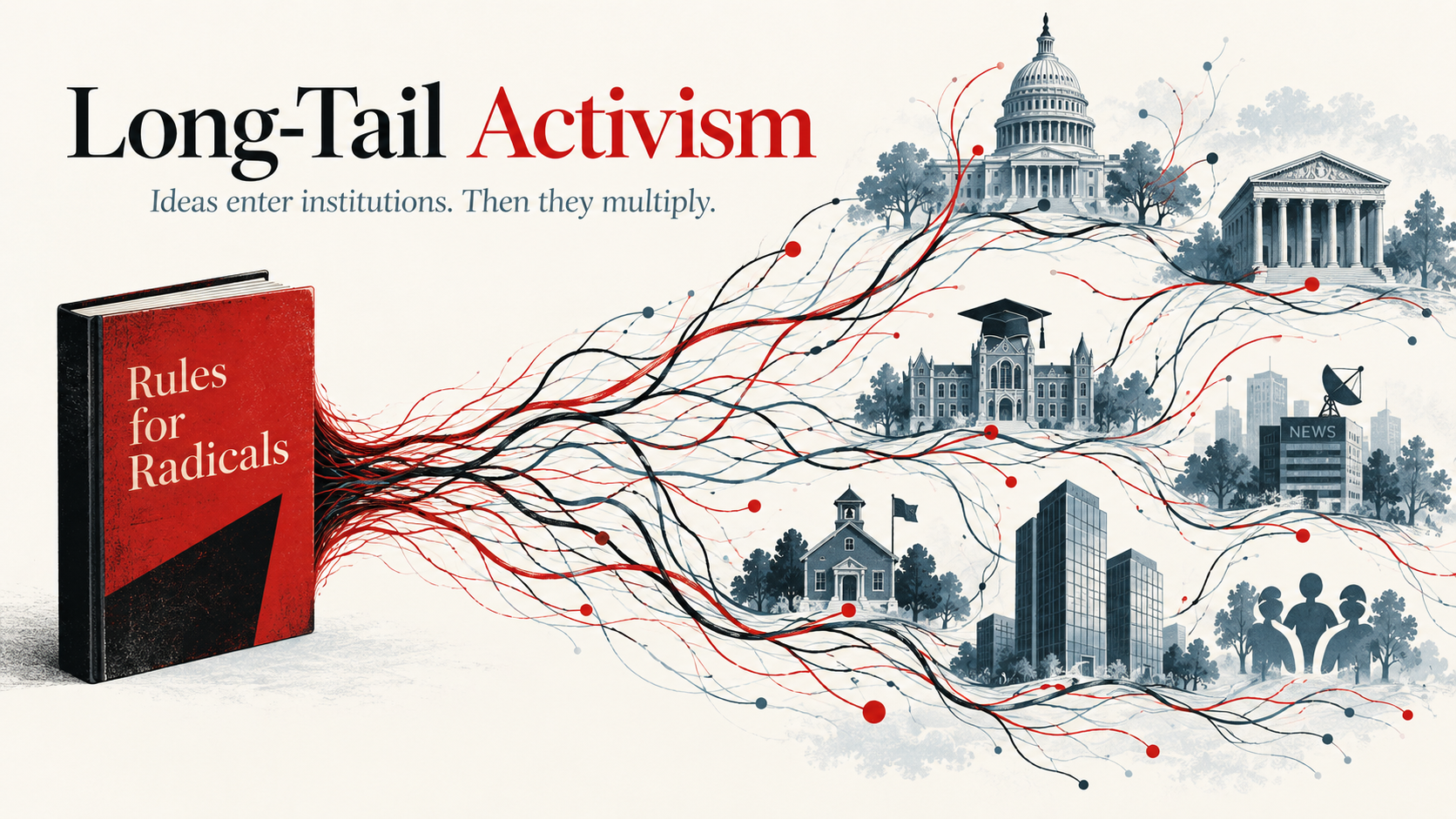
My last essay showed how Long-Tail Activism has made anti-Americanism go viral. In this essay I want to show how technology threatens to help those activists use violence to create the next threat: long-tail terrorism.
Once Hasan Piker told his over three-million followers that suicide bombers should switch to drones, long-tail terrorism became, in my opinion, inevitable. My goal is to inform the public in the hope that our country will learn what it failed to learn on September 11, 2001, and prepare itself against this future threat before it becomes a reality.
Traditional activism requires activists to identify a grievance, organize people, choose a target, and keep applying pressure. Saul Alinsky was very good at this, but in his model, every new fight required an organizer. Once the campaign ended, the targeted institution usually carried on very much as before.
So too short-tail terrorism requires actual terrorists, organized, trained, and willing to die for their cause.
Long-tail activism removes the limitations of short-tail activism by embedding the activism inside institutions. Once a government agency, university, corporation, nonprofit, professional association, or media organization begins treating activism as part of its purpose, the institution spreads the ideas for the activists, incorporating activism into hiring, training, regulations, professional standards, funding requirements, and everyday organizational culture. New employees may have no idea where those ideas came from, but they inherit the system.
One institution changes another, which changes another, until the original activists are no longer necessary. The system reproduces the activism on its own and the activism goes viral. That’s what makes it long-tail.
Institutional capture explains how activists get into an institution. Long-tail activism explains what happens after they succeed and the institution becomes the activist.
The question I want to explore now is what happens when the same distributed, self-propagating model moves from activism to political violence.
We already saw this with the assassination of Charlie Kirk, who was killed by a trans-activist acting on his own after being radicalized by the media. I would argue that the rioting and looting we saw in the ‘summer of love’ after George Floyd died was terrorism as well. Black Lives Matter and ANTIFA joined in with the riots, but for the most part, there was no organizational structure behind them.
9/11 was an example of short-tail terrorism. A terrorist organization actively planned, coordinated, and carried out the attack, and although it was successful, most such organized attacks are uncovered and prevented long before they ever take place.
Now, 25 years later, Zohran Mamdani, who celebrated July 4th by sitting in front of George Washington’s desk to tell us how horrible of a country we have, is the mayor of the very city in which the Twin Towers were destroyed by Islamic terrorism.
We have learned nothing. We’ve in fact learned less than nothing. Millions of Americans now think either that we did 9/11 ourselves, that Israel did it, or that we somehow deserved it. Some of the people who voted for Mamdani seemed to do so, not in spite of his sympathy toward people associated with terrorism, but because of it.
Mamdani has given them plenty to work with. In a 2017 rap song called “Salam,” he said, “My love to the Holy Land Five. You better look ’em up.” The Holy Land Foundation defendants were ultimately convicted of financing Hamas. During his 2025 mayoral campaign, Mamdani repeatedly declined to condemn the phrase “globalize the intifada,” though he later said he would discourage its use. The Second Intifada included suicide bombings and other deliberate attacks on Jewish civilians.
After October 7, Mamdani mourned those killed “across Israel and Palestine,” but immediately turned to Israeli occupation, Gaza, and Netanyahu’s response. When later asked whether Hamas should disarm and relinquish control of Gaza, he declined to take a position. This was after Hamas had deliberately murdered civilians on October 7.
Abdul El-Sayed, the Democratic nominee for Senate in Michigan, has taken a different approach, but his explanation for terrorism follows a similar pattern. In a July 2025 campaign event discussing why people become terrorists, he talked about the “pain and frustration” and “lack of agency” terrorists feel, and asked what America does to create that pain.
After the March 2026 attack on Temple Israel in West Bloomfield, Michigan, El-Sayed said, “Hurt people hurt people,” and argued that “violence always begets violence.” This one hit particularly close to home. I dated a girl for three years whose family attended that temple, and although I’m not Jewish, I went there with them on several occasions.
El-Sayed later apologized for those remarks and said he had been trying to provide context. But that is precisely the problem I am describing. When someone attempts to attack a synagogue, my first concern is stopping and condemning the terrorist. Understanding his grievance can come later.
El-Sayed has every right to criticize American foreign policy. On September 11, 2021, he mourned the nearly 3,000 people murdered on 9/11, but said that the following day he would mourn roughly one million lives lost in wars carried out “in the name of my country.” He has since unequivocally called 9/11 terrorism and said that “nothing can justify the murder of innocent civilians.”
The issue is not whether Mamdani or El-Sayed personally commits or orders terrorism. They do not. The issue is what happens when political violence is repeatedly discussed through the grievance that supposedly produced it. One person supplies the grievance. Another explains the anger. Another excuses the violence. Another celebrates the people who commit it. Eventually someone listening decides to act.
Some of them, should they have the means, will be willing to commit acts of violence.
Hasan Piker, the king-maker of the Democratic Socialists of America, said back in 2019, “America deserved 9/11,” adding that “we totally brought it on ourselves.” Piker has said that Hamas is “a thousand times better than Israel,” and when Jon Favreau later gave him an opportunity to clarify whether that was simply provocative rhetoric, Piker said, “I do mean it.” He went further and said that, as a lesser-of-two-evils choice, he would choose Hamas over Israel “every single time.”
I mentioned Piker telling terrorists to use drones. Let’s be specific. While talking about the Taliban, Pakistan, and Islamic terrorism in general, he argued that suicide bombing was obsolete and told his audience, “Just make fucking drones.” He even joked that anyone still using suicide bombers was doing it to be “old school,” and “for the love of the game.”
To Hasan Piker, terrorism is a game. Mamdani, El-Sayed, and others campaigned with this guy. It should not surprise us at all when some of the people who vote for those who support terrorism then act to commit it, trying to accomplish what Mamdani and El-Sayed want to do politically, through violence.
Piker has explicitly said that he hates America. In one widely circulated clip, Piker said, “I say I hate America all the time,” and responded to the charge that he hates the country by saying, “Yeah, I do,” adding that he says it “with my fucking chest.” More recently, he defended his right to say he hates America when he believes the country is “fucking over Americans.” Piker argues that his anger is directed at the American government and its policies rather than at individual Americans.
In another clip, while mocking fears about immigration and demographic replacement, he said, “We’re gonna destroy the white race, bitch. That’s what we’re here to do.”
Long-tail activism has created an army of anti-American sentiment in the United States, and particularly among America’s youth. Many of the institutions that are supposed to protect us from terrorism have become parts of the activist network that increasingly supports terrorism; they will be ill-equipped to deal with long-tail terrorism once it fully emerges.
Long-tail terrorism will not look like the terrorism we are used to. There will be no organization claiming responsibility for the attacks, and in fact no organization involved. It will be committed by lone-wolf activists driven to violence by people like Piker, and by the mainstream media’s biased reporting.
The terrorists who attacked us on September 11, 2001, were willing to die. Al-Qaeda had to find people who believed in its cause strongly enough to deliberately kill themselves while murdering thousands of strangers. It had to recruit them, train them, move them around the world, finance them, coordinate them, and maintain enough operational security to keep the plot hidden. Every part of that process created risk for al-Qaeda. Every phone call, bank transfer, airline ticket, meeting, training camp, border crossing, and additional person involved created another opportunity for someone to notice what was happening. It is precisely this kind of risk that makes successful acts of short-tail terrorism rare.
Long-tail terrorism does not have any of those restrictions.
The long-tail terrorist does not have to be willing to die, and in fact does not necessarily have to be willing to go to prison. He does not have to join a terrorist organization, attend a training camp, meet a recruiter, receive orders, or even know another terrorist. He only has to become willing to commit political violence, and may well believe he can get away with it. That is a much lower threshold, and technology is steadily lowering it further.
The importance of drones is not that they can be used as weapons. The revolutionary change is distance. Technology increasingly allows the person committing an act of violence to separate himself from the violence. That changes the psychology. There is a profound difference between asking someone, “Are you angry enough to die for this?” and asking, “Are you angry enough to do this if you think nobody will ever know it was you?”
Long-tail terrorism does not require a central organization telling millions of people what to think. The ideas have been distributed through institutions and culture. The activist does not have to know Saul Alinsky, read Marx, belong to an organization, or even think of himself as an activist. He inherits a worldview from the institutions around him and from the influencers he listens to.
For most of the modern history of terrorism, one of the terrorist organization’s most difficult jobs was finding someone willing to die. Piker’s observation about drones, stripped of the jokes and politics surrounding it, is that technology makes terrorism far less risky, allowing it to become distributed, and to go viral.
I am not predicting that millions of Americans are going to become terrorists, but imagine what happens within a political culture that produces millions of people who have become convinced that America is fundamentally evil, and who can launch a drone attack with very little chance of getting caught. How much damage could four or five thousand people do?
When Hasan Piker made his comments about drones, he was probably thinking about actual terrorist organizations buying the Sunflower-200, which started out as a clone of Iran’s Shahed drones and has since been improved. These cost about $35,000 a pop, and given that Iran claims to have thousands of terrorists already in the United States answering to its Quds forces, we should be very concerned about that threat. Terrorists are also working with the Mexican drug cartels, and drones have become very active along our Southern border. We should be concerned about that as well. These are both, however, short-tail.
The Counter Extremism Project (CEP) reported in April 2026 that pro-ISIS online groups released a 42-page, step-by-step guide to constructing an FPV drone, along with separate material on weaponizing homemade drones. CEP says the material included parts/tools and detailed construction information.
Commercially available drones costing under $5,000 can carry payloads of 15-20 lbs. for several miles. Amazon carries the SwellPro heavy-lift fishing drone for about $2,299. It has a one-mile range, and carries 7 lbs.
The Anarchist Cookbook, published in 1971, tells people how to make the explosives. The technical knowledge to commit terrorism is now just as distributed as the ideology.
Long-tail terrorism will consist of disaffected youth listening to people like Hasan Piker, buying cheap drones – perhaps crowdfunded – modifying them to carry bombs and to remove any identifying information, and then launching them from areas where there are no cameras looking. Hasan Piker will be able to say he did not tell them to do that, even though he inspired it, and he is right – as long as he does not say anything actionable, he is not technically inciting violence. He is simply inciting rage, and then talking about how with drones, the terrorist need not die.
After 9/11, we built enormous systems designed to find organizations and plots. We look for terrorist financing, we monitor communications and share intelligence, and we identify networks and attempt to disrupt attacks while they are still being planned.
Long-tail terrorism is invisible to all of that.
One person can spread the grievance, while another can normalize hatred. Another can excuse violence. Another can celebrate the people who commit it. None of those people has to know the person who eventually acts, and though if one person did all of those things they would be inciting violence, having different people and different organizations doing those things separately in a distributed, disconnected manner, ensures that nobody is guilty, even though incitement occurs.
This brings us back to the lesson we should have learned on September 11, 2001, but did not: our enemies adapt faster than our defenses do. The next wave of terrorists will not be limited to Islamic terrorists who see Western freedoms as dangerous excuses not to fully submit to Allah. It will increasingly be disaffected American youth listening to anti-American revolutionary rhetoric and deciding that the time for revolution has come.
Our nation has no defense against this today, but that does not mean there is no defense.
Technology lowers the organizational cost, the financial cost, and most importantly, the personal risk involved in committing terrorism. Our defenses have to add those costs back in.
The FAA already requires that most drones be registered to use Remote ID. This is basically a digital license plate, and a compliant drone broadcasts identifying and location information while it flies. That is a good start, but a national-security system cannot be built around the assumption that someone planning a terrorist attack will voluntarily obey FAA regulations.
We need to move toward a system in which drones are extremely difficult to operate anonymously. Identification should be built deeply enough into commercially manufactured systems that defeating it requires deliberate tampering rather than just a setting change. Identification systems should be tied directly into the functionality of the drone, to make removing it as difficult as possible. Deliberately defeating identification requirements should also carry serious criminal penalties.
Second, we need detection.
We spend enormous amounts of money screening people entering airports, stadiums, government buildings, military installations, power plants, and major public events. We also have to think about the airspace immediately around them. This means developing inexpensive systems capable of telling security personnel when an unidentified drone has entered protected airspace, tracking it, determining whether it belongs there, and giving authorities enough warning to react.
Third, detection without the legal authority to act is useless.
Federal agencies currently have limited authority to counter threatening drones under specific circumstances, but state and local police generally cannot interfere with an aircraft an officer considers suspicious. That made sense when the federal government was trying to prevent thousands of local jurisdictions from creating chaos in the national airspace, but it makes less sense when a police officer protecting a crowded public event has to wait for somebody hundreds of miles away to decide what can legally be done.
Congress needs to create carefully controlled counter-drone authority for trained state and local law-enforcement units, and these units need to have inexpensive anti-drone technology (such as anti-drone drones), and the ability to use that technology.
Fourth, we need layered defenses, as there will never be one magic device that solves this problem.
Military facilities, government buildings, major transportation hubs, energy infrastructure, large public gatherings, schools, houses of worship, and other likely targets need different levels of protection based on risk. We do not need the same defensive system everywhere. We need systems that can be scaled according to the consequences of an attack.
Fifth, manufacturers have to become part of the security system.
Cars have vehicle identification numbers. Their manufacturers maintain records. Safety standards are built into their design and stolen cars can be entered into national databases. This makes automobiles traceable. Drones should be as well.
Regulation should, of course, scale with capability. A tiny recreational drone and a large aircraft capable of carrying a substantial commercial payload are not the same thing and should not be treated as though they are. The greater the capability, the stronger the requirements for identification, registration, traceability, and safe operation should become.
Sixth, law enforcement has to stop thinking exclusively in terms of terrorist organizations and begin thinking in terms of internal terrorist ecosystems. The First Amendment does not disappear because someone says something ugly, stupid, anti-American, or even sympathetic to terrorists, but law enforcement and intelligence agencies cannot allow politics to determine which forms of radicalization they are willing to recognize. A person advocating racial terrorism, Islamic terrorism, communist terrorism, anarchist terrorism, environmental terrorism, or any other form of political violence should be assessed by the same standard.
The question should not be whether the government approves of the grievance. The question should be whether someone is moving from grievance to violence, and as soon as the rhetoric crosses into incitement, arrests need to occur.
Hasan Piker has the right to say things I find reprehensible. Zohran Mamdani has the right to criticize the United States, and Abdul El-Sayed has the right to argue that American foreign policy produces blowback. They have the right to spout anti-American propaganda, and as Americans, they have the right to run for office. All of that is of course true, but it does not mean we have to be stupid. When such people cross the line into incitement, they should be prosecuted accordingly.
There is also a larger solution, and it is the one Americans will be least comfortable discussing: long-tail terrorism cannot exist at any scale without the long tail.
There is a difference between tolerating anti-American ideas and allowing institutions whose purpose is education, journalism, government, charity, or professional development to become engines for producing them. We need to take back the institutions, and that takes us back to Long-Tail Activism.
If our schools teach generations of young Americans that their country is fundamentally evil, our media explains political violence according to whether they sympathize with the grievance behind it, our universities turn activism into part of their institutional mission, and our political leaders increasingly describe terrorists through the injustices that supposedly produced them, we should not be surprised when some of the people immersed in that environment eventually decide that violence is justified. A small portion of those will act, and that portion grows when people think they can get away with it.
You’ll note too that I am spending a lot of time discussing Islam and terrorism. That is because historically this has been the greatest threat. I’ve seen left-leaning ‘studies’ claiming that most political violence comes from the political right, but those ‘studies’ play fast and loose with what they categorize ‘political,’ what they consider ‘right’ or ‘left,’ and what they consider ‘extreme.’ One such ‘study’ called Charlie Kirk’s assassin ‘extreme right wing.’
What is coming is not going to be primarily Islamic terrorism so much as revolutionary terrorism, and it will come from disaffected youth, many of whom come from affluent families.
After September 11, we spent trillions of dollars fighting the organizations that attacked us. Long-tail terrorism presents a much more difficult question: what happens when there is no organization to fight?
There may be no training camp to bomb, no terrorist financier to follow, no recruiter to arrest, and no communications network to penetrate. The person spreading the grievance may have no idea who will eventually act on it. That is what makes long-tail terrorism different. The ideology and the technical knowledge are distributed, along with the capability. The violence will follow.
We cannot prevent that by treating every angry young American as a terrorist, nor should we try. We can protect the First Amendment while rebuilding institutions that teach young Americans that their country is worth preserving rather than destroying. We can make anonymous attacks more difficult. We can harden likely targets. We can give law enforcement the tools and legal authority necessary to respond to a threat that no longer looks like September 11.
September 11 taught us what happens when our enemies discover a vulnerability before we recognize it ourselves. Twenty-five years later, we should not need another catastrophe to learn the same lesson, and nor do we need thousands of small ones.
Our enemies adapt. We must learn to do so as well, and we must learn to do so before the lesson is delivered to us in blood.