Louis Philippe II, Duke of Orléans, was one of the highest-ranking nobles in France and a cousin of King Louis XVI. He was about as close to the monarchy as someone could get without wearing the crown, but unlike much of the aristocracy, he embraced the Revolution.
He opened his Palais-Royal estate in Paris to political clubs, radical speakers, and revolutionary parties. The Palais-Royal became one of the major centers of revolutionary agitation. Some historians even view it as one of the incubators of the Revolution, and as the Revolution radicalized, so did he.
He renounced his noble title. He abandoned the name “Orléans,” and adopted the name “Philippe Égalité.” When King Louis XVI was put on trial, Philippe Égalité voted in favor of executing his cousin.
This did not save him, as once the Revolution moved into the Terror phase, loyalty no longer helped.
Revolutionary systems radicalize through competition, with every faction needing to prove itself more revolutionary than the last, and eventually Philippe Égalité was accused of insufficient revolutionary purity based on his royal birth, and based on his son, also of royal blood, having very wisely fled France.
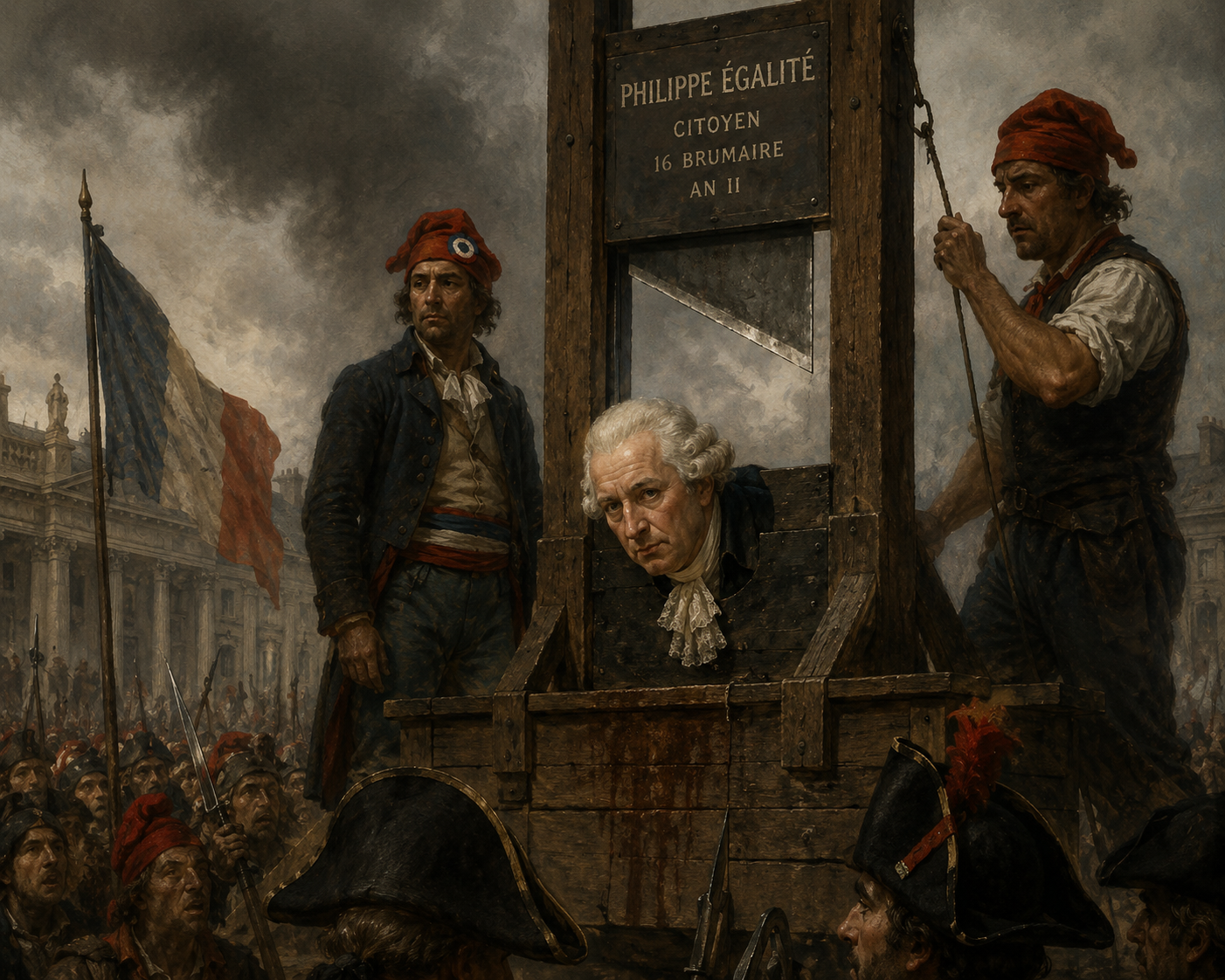
And so it was that on November 6, 1793 (16 Brumaire, Year II, in the calendar the Revolution had created), the man who had renounced nobility, changed his name to the French word for ‘equality,’ supported the Revolution, enabled the radicals, and voted to execute his own cousin, was guillotined.
Philippe Égalité demonstrates that revolutionary movements built upon unconstrained political power do not stabilize, and eventually eat their own.
Restraint is a recurring theme throughout Western Civilization. The Judeo-Christian God gave man free will. Lucifer embraced free will but wanted it unrestrained by God’s moral order, and rebelled.
One person in a closed system can of course do whatever they like, but when we start to add other people, freedom needs to be restrained by morality to function. Similarly, power can be absolute if we only care about those in charge, but once we start worrying about everyone else, power needs to be restrained.
Without restraint, the logic of ideological purity never ends. These kinds of revolutions are like ropes lit from both ends, burning off first the extremes and then moving ever inward until everyone is gone, unless someone like Napoleon intervenes. We are increasingly making the same mistake by confusing democracy with liberty. The two things are not only different, but are often in direct conflict with one another.
Democracy is the right of a people to vote to decide what they will do. Some compare it to two lions and a gazelle deciding what to have for dinner.
Liberty is the right of the individual to live his or her life however they want, provided they allow others to do the same. Liberty is what protects the gazelle from the lions, and it is also what protects us from one another in a country where we select representation based on majority rule.
Democracy decides who controls the government. Liberty limits what the government can do. The Founders understood this distinction very well, which is why the United States was founded not as a democracy, but as a constitutional republic.
In a functional system, liberty restrains government, morality restrains liberty, and government enforces the law. All three are necessary and the balance between them matters. Every system that throws out any one of those components fails.
James Madison argued in Federalist No. 10 that the greatest threat to free government was not the minority, but the majority. A minority can be voted down whereas a majority can vote to steal from any minority it chooses. It can, in fact, steal from all of them, even if when combined those minorities form a majority. The central challenge of government, then, was not allowing the people to govern themselves, but limiting the scope and power of government.
Imagine seven groups of equal size. Someone suggests stealing all of the wealth from one of the groups – call it ‘the rich’ – and everyone votes. The motion to steal all of the wealth from the rich passes, and the rich are now poor.
Next someone suggests stealing all of the wealth from the next richest group. The motion passes with support from six of the seven groups, and now the second group is also poor. Someone suggests stealing all of the wealth from the next group and the same thing happens, and again until all of the wealth from all of the groups is gone.
Nobody would have voted to have their own wealth stolen, but by breaking society up into pieces and having each person vote against all of the other groups, that is precisely what happened.
Preventing this is the purpose of constitutional restraint. The Senate, the Electoral College, separation of powers, judicial review, federalism, and the Bill of Rights all exist to slow power down, fragment it, and limit its scope. The defining characteristic of a republic is not the vote, but that there are things the government is not allowed to do, even if a majority of the public wants it to. Our Constitution, in fact, specified what the government can do, and specifies that it can do nothing else.
Even when the government should do something, the founders understood that the more local government is applied, the more responsive it will be, which is why the 10th Amendment left all powers not explicitly given to the Federal Government to the states or the individual.
We understand the need to constrain kings, so it should not be hard to understand the need to constrain other forms of government as well. People fear dictators, but there have been very benevolent dictators throughout history. Marcus Aurelius is a great example. He could have been an absolute despot, but he wanted to rule justly.
Democracies can be worse than kings. As Thomas Jefferson put it, “I would rather have one king 3,000 miles away than 3,000 kings one mile away.” Thomas Jefferson was not the only founder who believed democracy to be worse than monarchy, and had France followed Lafayette and built a constitutional republic, their Revolution would have been a success.
Human nature does not improve just because people group together. Majorities are more than capable of becoming every bit as selfish, emotional, shortsighted, and tyrannical as kings. In many cases, they are worse, as majorities can convince themselves that anything they do is morally justified. They are, after all, the majority, and the majority rules.
Mobs do not act as a group of moral individuals so much as a single immoral individual. The perceived morality of being a majority makes mobs narcissistic and psychopathic by nature, and as such we should fear the form of government less, and the scope of government more.
The French Revolution demonstrated this very clearly. What began as a revolution against aristocratic abuse quickly became a revolution against anyone accused of sympathizing with aristocrats, then against those insufficiently loyal to the revolution, and finally against rival factions within the revolution. Had it not been for Napoleon it would not have stopped there – it truly was a rope burning from both ends.
The underlying problem was not monarchy or empire, but unconstrained human nature, and the same impulses that corrupt political systems also corrupt economic ones, as the incentives are the same. Human beings respond to power, self-interest, fear, envy, greed, security, and moral justification regardless of the system they inhabit.
Consumption tends to concentrate in cities whereas production generally occurs outside of them. Producers and consumers often have very different political and economic incentives. Consumers benefit from lower prices, subsidies, wealth transfers, and public spending. Producers benefit from property rights, investment, profitability, and economic freedom.
This naturally pits cities against the rest of the country, or as we call it in America, New York and California against ‘fly over country.’ Most people live within cities, so in a democracy, consumers have the larger hand.
This dynamic is also what popularizes socialism: those in cities primarily work in banking, or in service roles, and are far removed from the farms and factories where physical goods are produced. They don’t know what all goes into putting food in the grocery store and have no real reason to care. They have every incentive to vote to get more food for less money.
Karl Marx assumed production was at worst fixed. He assumed that a nation that shows the capability to produce a certain amount should be able to produce that amount even if incentives change, but history has proven him wrong. History has shown that human beings respond to incentives, and incentives matter. When you disincentivize production by taxing it too much, production suffers.
We evolved to respond to incentives. Maybe that is selfish. Maybe not. Whatever the case we cannot unwire hundreds of thousands of years of evolution just because Karl Marx said that we should. The notion that we can is absurd, and attempts to rewire societies around what is not possible have killed hundreds of millions of people in the 20th century alone.
Our ability to kill at scale has only grown, so the 21st century has the capability to kill even more people if we do not get this right, and Marx’s vision of a stateless utopia of unrestrained freedom is exactly what Satan wanted when he rebelled against God. In both cases it sounds good on a surface level, but falls apart once you think it all the way through.
Once consumers gain the ability to permanently subsidize themselves through the taxation of producers, the majority will naturally continue increasing taxes, spending, redistribution, and public benefits until production is no longer profitable. Consumption initially rises to meet the increased demand, giving an initial illusion of success, but the damage arrives once investment collapses, productivity declines, and producers cease operating. Then people starve.
This pattern has repeated throughout history.
Venezuela was once among the wealthiest countries in South America. Over time, the Venezuelan government reorganized the economy around redistribution rather than production. Industries were nationalized. Economic incentives were distorted. Consumption was subsidized through oil wealth and public spending.
At first things appeared to succeed, which is why socialism remained popular as long as it did. Then production collapsed, inflation exploded, investment disappeared, and the economy fell apart. The country found itself struggling with shortages, starvation, black markets, and mass migration. It got so bad that the government suggested people breed rabbits and eat them to survive.
None of this happened through monarchy or dictatorship either. Hugo Chávez and Nicolás Maduro were both popularly elected. Maduro did not stay in power through democratic means, but he did get there that way, and Chávez was popular right up until he died.
Nor was Maduro worse than Chavez. Margaret Thatcher said that the reason socialism fails is that “you always eventually run out of other people’s money,” and Maduro had the misfortune of being the guy in charge when the money ran out.
Argentina is now attempting to reverse the same collapse. After decades of inflation, subsidies, corruption, state intervention, and economic stagnation, the country is attempting to restructure itself around consumption. As expected, the transition is painful even as the economy starts to grow.
The same thing occurred in Britain under Margaret Thatcher. Entire industries that had depended upon state protection and government support contracted or disappeared entirely. Critics focused on the collapse of those industries and the pain associated with the transition while supporters focused on declining inflation, renewed competitiveness, rising productivity, and long-term growth. Critics pointed to the millions of people who had lost their jobs. Supporters pointed to the fact that most of them found new jobs that paid more.
Both sides were correct. Removing taxes on the productive parts of the economy and ending support for the unproductive parts meant that those who produced what people wanted thrived, while those who did not struggled. Some would call that fair, but others of course look at the people who lose their jobs when industries are no longer needed. We are a compassionate species. Our hearts bleed for the displaced even when we know some forms of economic churn are beneficial in the long term.
The Thatcher-era restructuring effectively reset the British economy. The recession from 1979 – 1981 was brutal, but from 1982 until the early 2000s, Britain experienced one of the longest sustained expansions in its modern history, and though many industries in Argentina are struggling, the economy is growing overall.
One of the great recurring patterns of human history is that people born under oppression tend to dream of freedom, while people born free often dream of chains. The former have experienced the danger of tyranny directly. The latter often assume such dangers no longer exist.
But those dangers never go away.
Tyranny is still out there, not because human beings are evil, but because human beings are human. Self-interest does not disappear when exercised collectively, and a majority is not only capable of abusing power, but apt to see such abuse as just.
Our founders understood that if the government does not have the kinds of power businesses want, there is no point in bribing, and it is no surprise that as the government has grown, so too has corruption. So too has fraud.
It is also impossible to have personal freedom without economic freedom. We are all a part of the means of production, so placing the means of production under government control means placing the people under government control. Every subsidy, tax, or mandate that pushes production away from the things people want to buy, and toward things they do not, makes us as a society less well off by making the things we want more expensive. Someone, after all, has to pay for those things.
Even a laissez faire system will have a defense industry, as just one obvious example of an industry based purely on government demand. We also need roads and a host of other types of infrastructure that would be difficult to maintain through private means, so there will always be a need for the government to take from what is profitable to pay for what is not.
The question is where that ends. My answer is that the government should do things that make the rest of the economy more efficient, and that it is OK to tax the rest of the economy for that, but the government should not do things that make the economy less efficient without very good justification, and now that the IPCC has admitted that climate alarmism was based on models it knew were inaccurate, we should be very careful letting the government justify making us poor, as it has done to great effect in Canada and across much of Europe, through net-zero mandates.
Lizzie Magie created the game Monopoly in 1903 to demonstrate the dangers of free markets, and it tied in very neatly with Karl Marx’s critique. This game was specifically designed to force wealth to accumulate into ever fewer hands until one person won.
That works in a game designed to make it work, but in the real world, free markets don’t work that way. Every monopoly that has ever existed that did not have direct government support either did not last long before some other company emerged to challenge it, or it became obsolete and was replaced by something else. The only exception is the New York Stock Exchange – which was a monopoly for 110 years, but no longer is.
Even where there are temporary monopolies, they do not last by raising prices so much as by reducing them faster than can competitors. The notion of monopolies using their position to take advantage of consumers may be theoretically possible, but if there are any examples of that happening without direct government support, I have never been able to get anyone to name one, and we spend an inordinate amount of time and resources fighting this particular boogeyman, even though he has never shown up.
We do so by tilting toward a very different boogeyman that has appeared many times. In addition to the French Revolution, we have the Soviet Revolution, Mao’s Cultural Revolution, the Khmer Rouge, the Iranian Revolution, and countless others throughout human history.
Revolutions sometimes lead to positive outcomes, as evidenced by the upcoming 250th Anniversary of the United States – which worked because it restrained government – but even as we turn 250 some of the most popular voices in our country will point to the Revolution, not as the birth of our nation, but as the funeral for all of the people our country has supposedly oppressed.
We do live in an oppressive world, but the oppressor is the planet, which has a myriad of ways to kill us.
Life being anything other than brutal and short is a new phenomenon, and though we cannot undo millions of years of evolution in just a few generations, gender roles changed remarkably fast. Women today have all the same rights as men, and that has been true for decades.
People forget that before Thomas Jefferson wrote, “all men are created equal and endowed by their creator with certain unalienable rights,” the notion that all men were equal had never been considered, and slavery existed in all corners of the Earth.
Perhaps more to the point, these things happened in the past, and we cannot change the past. We can learn from the past, but even then the notion that people who did not live in those times owe something to people who also did not live in those times, because people who are long since dead did things to other people who are also long since dead, all based on what people look like today, is absurd, and if we ever want to move beyond racism and live in the world as true equals, that kind of thinking needs to stop.
The problem is that we don’t really want to be equal. We want that for others, but we all want more for ourselves. We want to be exceptional.
And unfortunately, people think that if they can gain a majority somewhere they can vote for whatever they want. It is hardly surprising that so many people want other people’s money. This is the ideology of grievance, and ideology, like a siren, calls societies onto the rocks.
Human beings are neither good nor evil, but a mix of the two, and we cannot live under any ideology if taken too far. We are not capable of that, needing both liberty, and restraint. Liberty abhors government, and yet liberty can only exist if the non-aggression principle is enforced.
Liberty is not the problem today, though. Empathy and compassion are. Though empathy and compassion are wonderful traits we should all have in our daily lives, when societies turn them into an ideology of absolutism and practice them without restraint, they become suicidal.
Louis Philippe II, Duke of Orléans was thinking ideologically when he changed his name to Philippe Égalité and voted to kill his cousin, the king. He inverted his morality and acted without restraint. Did his countrymen thank him for helping overthrow the monarchy?
No they did not. They cut off his head instead.
And that is where his kind of thinking always leads.