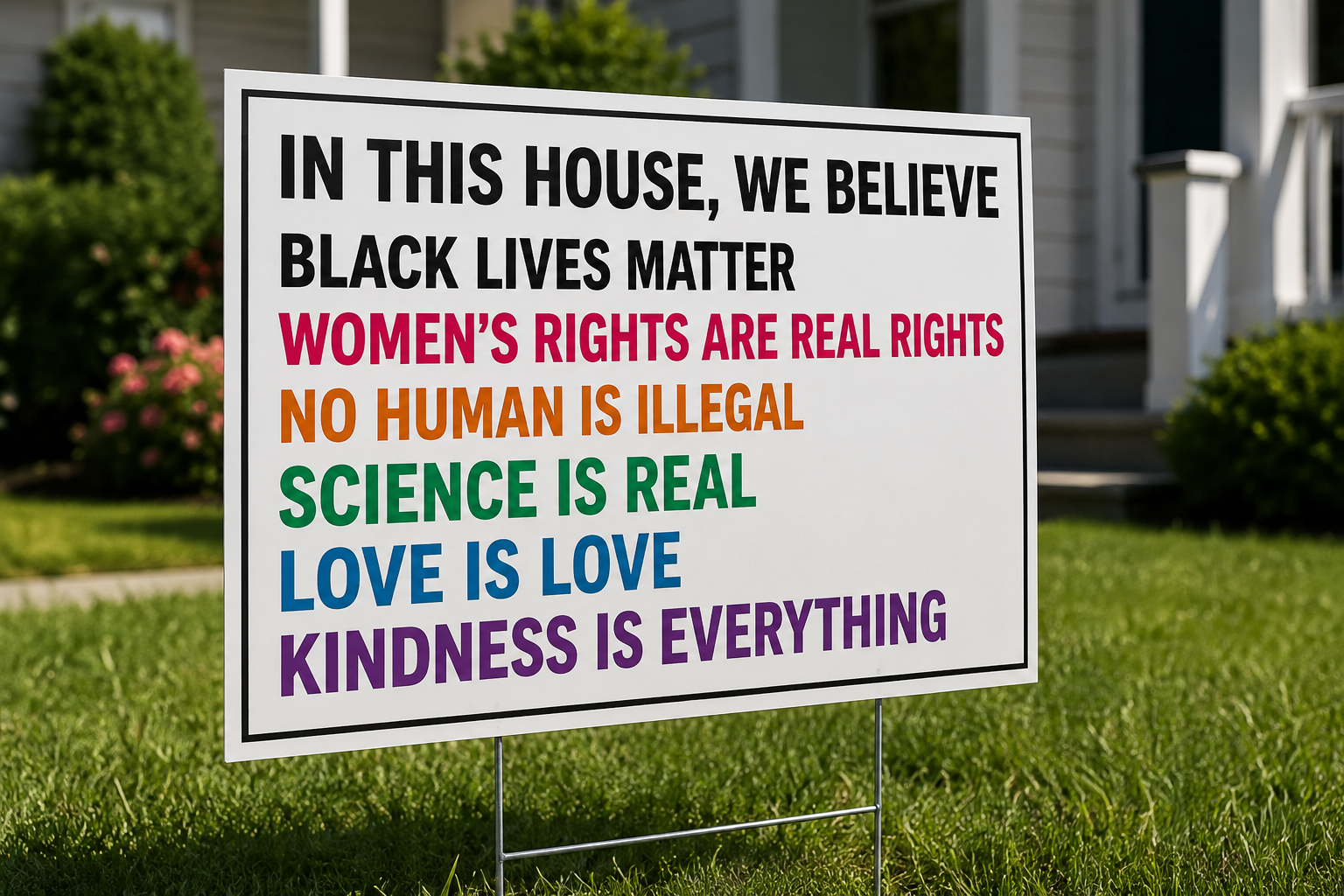
We’ve all seen the yard signs: “In this house, we believe Black Lives Matter, Women’s Rights are Real Rights, No Human is Illegal, SCIENCE IS REAL, Love is Love, Kindness is everything.”
The first statement sounds simple enough until you realize that it presupposes the existence of a large number of people who disagree. Where, exactly, are these people? In a nation with a population of over 330 million, there will always be a small number of racists, but as a political force white supremacy is dead.
The second statement sounds similarly benign. Of course no human is illegal. But the thing is that this presupposes that people cannot do illegal things, and of course people can.
“Women’s rights are real rights” is also a benign statement. Of course they are. The real question is what rights, specifically, do women have that men do not. Rights that are specific to a certain group generally come at the expense of other groups, and in this case that would be unborn children.
Whitney Houston sang, “Learning to love one’s self is the greatest love of all,” but whenever I hear that lyric, I think making self-love the greatest love of all not only goes against the golden rule, but it is also inherently narcissistic. Also, are we supposed to excuse pedophilia based on ‘love is love’?
Some love is better than others, and some love is just plain wrong.
Finally, we have ‘kindness is everything’. Certainly kindness is something, but there are many things, and being kind to the wrong people at the wrong time can turn suicidal.
Of all the slogans on the sign, however, one deserves special attention: ‘Science Is Real.’ Today, many people keep the language, credentials, and prestige of science while quietly abandoning its methodology. Many wear the garb of science while serving power, money, ideology, or something else, and many put up yard signs when in reality what they believe is what they are told is ‘science’ by those who have no interest in science proving them wrong.
Science is not a set of approved conclusions. It is a method: empirical observation, transparent data, and falsifiability. If a hypothesis is disproven, theories are supposed to change, and when the label of “science” is kept but the method is abandoned, the result is propaganda and control.
During the Renaissance, the Catholic Church was the greatest supporter of science in Europe, funding universities, building observatories, and supporting scholars across the Catholic world. For a long time, the Church was the most important patron of scientific inquiry in the Western world.
But there was a catch.
Scientific findings were expected to remain consistent, not only with Biblical interpretation but with official Catholic doctrine as well. The Church did not object to science as long as it stayed within approved boundaries, but whenever evidence began to contradict established theological teachings, the church intervened.
Take the case of Giordano Bruno. He was chained to a stake, stripped of his clothes, gagged, and burned alive. Bruno argued that the universe was infinite, containing many suns orbited by many worlds, which was an idea that, at the time, threatened the Church’s doctrine. He died a slow and excruciating death in spite of the fact that he was a pious and faithful man.
The most famous example is Galileo Galilei. Galileo made astronomical observations that supported Copernicus’s heliocentric model that the Earth, and the other planets, revolved around the Sun. This directly challenged the Church’s long-held view that the Earth was motionless and at the center of the universe.
Galileo was a devout Catholic who believed God had written both the Book of Scripture as well as what Galileo called ‘the Book of Nature’, and he believed both deserved to be studied. When his findings clashed with official doctrine, the Church forced him to recant under threat of torture, placed him under house arrest for the rest of his life, and banned his books.
The church is no longer suppressing scientific discovery (and is still a prominent supporter of science), but the underlying motivations that drove the church are very similar to the motivations that drive the suppression of modern science today.
Subjugating science to ideology is not unique to the Christian world either. Under Islam, openness to Greek philosophy and rational inquiry gave way to greater emphasis on religious orthodoxy. The renowned physician and chemist Abu Bakr al-Razi (Rhazes) was reportedly beaten on the head with one of his own books until he went blind, for expressing views that offended religious authorities. Ibn al-Haytham (Alhazen), widely regarded as one of the founders of the scientific method, is believed to have feigned insanity while imprisoned to avoid execution under the Fatimid Caliph Al-Hakim.
In Confucian China, imperial authorities often subordinated astronomical and scientific observations to maintaining the official cosmic and social order. Court astronomers whose predictions contradicted the emperor’s divinely sanctioned calendar could face demotion, exile, or execution.
Religious authority does not always oppose inquiry – it often supports it – but it insists that science must remain subordinate to doctrine. When evidence conflicts with ideology, the evidence is disallowed.
Corporate Profit and Manufactured Doubt
For decades after the link between smoking and lung cancer became clear, tobacco companies poured money into studies, think tanks, and friendly scientists to deny, downplay, or muddy the evidence. Their internal strategy was captured perfectly in a famous memo: “Doubt is our product.” They didn’t need to prove smoking was safe. They only needed to create enough apparent scientific disagreement to delay regulation until they could replace American demand with demand overseas. To accomplish this, big tobacco cherry-picked data, funded studies designed to sow confusion, attacked legitimate researchers, and created front groups that only looked independent.
A more modern version would be Al Gore. With no background in climate science beyond one class on greenhouse gases, Gore positioned himself as a leading global authority while putting together an investment group to manage carbon output. He aggressively promoted carbon cap and trade systems that, had they been implemented in the United States, would have made him a billionaire overnight.
For decades, companies like DuPont and 3M knew that PFAS chemicals (used in nonstick cookware, waterproof clothing, food packaging, and firefighting foam) were highly toxic and persistent. Internal documents show they had evidence of liver damage, birth defects, and other harms as early as the 1960s, yet they suppressed studies, misled regulators, and continued widespread production. They used the same tactics as Big Tobacco: attacking independent researchers, hiding internal data, and creating doubt about the dangers while the chemicals spread around the globe.
The sugar industry distorted nutrition science through the 1960s, when early research began linking sugar consumption to heart disease, the Sugar Research Foundation secretly paid Harvard scientists to write a major review that downplayed sugar’s risks and shifted the blame almost entirely onto saturated fat and cholesterol. The funding was not disclosed, and the paper, published in the New England Journal of Medicine, helped shape decades of dietary guidelines that focused on fat while giving sugar a relative pass.
In all of these examples (and there are many more), the language of science was used to advance positions for financial gain. The “science” was arranged afterward to justify pre-ordained conclusions, and even today, after the IPCC has admitted that it has been driving alarmism by using extreme models it knew were inaccurate, the ‘science’ of climate alarmism persists deeply within the mind of most yard-sign wielding households.
Ideological Pseudoscience
Sometimes the corruption of science is purely ideological, and one of the clearest and most disturbing examples is the Nazi regime’s Ahnenerbe.
Created in 1935 by Heinrich Himmler as an SS research institute, the Ahnenerbe existed to prove Aryan racial superiority, and the mystical destiny of the Nazi state. They sent expeditions to Tibet, Scandinavia, and the Middle East looking for evidence of ancient Aryan civilizations. They measured skulls, conducted bizarre archaeological digs, and produced academic-looking papers that always reached the same conclusion: the Aryan was the ‘master race’. When evidence did not support the ideology, it was ignored, distorted, or fabricated. Falsifiability, the heart of real science, was rejected outright.
The Ahnenerbe used the trappings of science, including institutes, academic titles, expeditions, laboratories, and scholarly language. But it was never science. It was propaganda.
On the other end of the spectrum, biologist Trofim Lysenko rose to power in the Soviet Union by promising that Marxist ideology could reshape agriculture. He rejected genetics as “bourgeois science” and claimed that plants and animals could be permanently transformed through environmental conditioning. Soviet leaders loved this idea as it fit their ideology to a tee.
Lysenko’s theories were enforced through the rule of law. Dissenting biologists were fired, imprisoned, or executed, and soviet agriculture suffered catastrophic failures as a direct result. Millions of people starved to death.
In both Nazi Germany, and the Soviet Union, the word “science” was hijacked. Real scientific institutions, language, and procedures were used, but the scientific method was not. Evidence was only acceptable if it confirmed the pre-chosen political or racial conclusions, and the same thing happened in Mao’s China, and a host of other places where actual science took a back seat to one-party rule.
The moral of the story is that when ideology fully captures the process of ‘science,’ the word ‘science’ becomes a weapon. The prestige and authority of science are used to silence opposition, justify atrocities, and close off lines of inquiry. The method dies, but the label remains, giving the worst ideas the appearance of objective truth, and giving those who believe falsehoods the perception of being intellectually superior to those who do not.
The underlying corruption is the same one we saw with religious authorities and corporate interests: power decides the conclusions first, then demands that “science” support them.
Modern Political and Ideological Capture
This same pattern continues today, often with the approval of media and academia.
The famous Card-Krueger study on minimum wages claimed that raising the wage did not hurt employment, and may even increase employment levels. This quickly became accepted wisdom even as later studies using better data found that higher minimum wages did cause higher levels of unemployment, especially for low-skilled workers.
Another great example is the Hockey Stick Graph by Michael Mann, which became a central visual for catastrophic global-warming claims. Questions about its statistical methods, proxy selection, and data handling were often dismissed or downplayed, even after Climategate emails showed internal concerns about how the science was being presented.
Michael Mann’s team used a statistical method that gave extra weight to any tree-ring records that showed a strong upward trend in the 20th century, while downplaying or ignoring records that showed normal ups and downs in earlier centuries. When other researchers later tested the same method on completely random numbers (with no pattern), it still produced a nice, clean “hockey stick” shape.
In other words, the methodology produced the hockey-stick shape they were looking for independently of the data, but the graph was so persuasive that millions of Americans still believe in it to this day.
Claims about gun violence have also been manipulated. A study titled, Violent Death Rates: The United States Compared with Other High-Income OECD Countries, by Erin Grinshteyn and David Hemenway, published by The American Journal of Medicine in March of 2016, found that the US gun homicide rate was 25.2 times higher than in other high-income OECD countries. For ages 15–24, the US gun homicide rate was 49 times higher, and the US accounted for 90% of all women, 91% of children (0–14), 92% of youth (15–24), and 82% of all people killed by firearms among the countries studied, despite having only about 31% of the combined population.
This paper (and earlier related work by Hemenway) is the primary source cited in media and policy discussions for the “US is an extreme outlier” narrative on gun violence in developed nations. Hemenway, however, never provided his data sets. He described his methodology, but refused to provide the underlying data.
John Lott used publicly available data to recreate Hemenway’s studies. On a per capita basis, he found America’s rate of mass public shootings to be remarkably average. Norway has a higher level of gun death than we do. American gun violence is also heavily concentrated in specific urban areas marked by poverty and gang activity. If we exclude gang activity, the United States is suddenly one of the safest countries.
When publishing More Guns, Less Crime, Lott made a minor methodological error in one early analysis that he corrected in later editions. That small mistake has been used to dismiss John Lott entirely.
With the help of the mainstream media, the political left has become very good at destroying the careers and reputations of any actual scientist that disagrees with them.
Restoring Credibility
Whether the driver is religious authority, corporate profit, personal enrichment, or political ideology, the corruption of science occurs in steps.
First, the desired conclusion is chosen and treated as sacred. Second, selective data and faulty methods are used to support that conclusion. Unfavorable evidence is ignored, downplayed, or attacked. Favorable evidence, no matter how weak or poorly designed, is repeated ad nauseum. The outward appearance of science is carefully maintained: academic language, institutes, studies, charts, and expert credentials.
Next, researchers who reach the wrong conclusions face professional attack, funding cuts, public ridicule, or worse. Minor errors in dissenting work are magnified into fatal flaws, while far more serious problems in supportive work are ignored.
Finally, media outlets and powerful institutions declare a “scientific consensus.” The public is told the matter is settled and that the debate is closed. Anyone who disagrees is treated as not credible and derided accordingly.
This pattern repeats across centuries and across different sources of power. The Catholic Church subordinated astronomy to doctrine. Tobacco companies manufactured doubt to protect profitability. The Nazis built the Ahnenerbe to “prove” racial superiority. Soviet authorities enforced Lysenkoism to flatter Marxist ideology. Modern examples, such as minimum wage studies, the hockey stick graph, selective gun violence narratives, and asymmetric scrutiny of dissenting researchers, show the exact same mechanics at work today.
The label “science” has enormous authority in the modern world, which is why it is so tempting, and so dangerous, when that authority is misused.
The growing public distrust in “science” is not anti-science. It is often healthy skepticism toward institutions that have repeatedly shown they value narrative over truth. People have watched “science” get twisted too many times, such that now when the label of science is used to shut down debate instead of encouraging it, people stop trusting the label.
Real science requires courage. It also requires admitting when you are wrong and changing hypotheses when the facts demand it.
Science is not a priesthood. It is a rigorous, and often uncomfortable process, never settled by consensus or institutional power.
Until we insist on the actual method instead of the label, we will continue to be ruled by corrupted data that serves powerful interests while covering up reality. The policies underwritten by such data tend to fail, and society follows.
John Lott is not apt to be killed for dissenting on gun violence with actual data, but on a cold, February morning in 1600, Giordano Bruno was. Hypatia, Servetus, Lavoisier, Ibn Rushd, al-Razi, and Ibn al-Haytham – all brilliant minds spread across centuries and civilizations – were persecuted once their findings threatened sacred conclusions held by those in power.
Today, the word ‘science’ is often just a slogan on a yard sign, and if we want to build a better tomorrow, we need to demand that it become something more again. We need to demand not just scientific credentials, but scientific methodology as well.