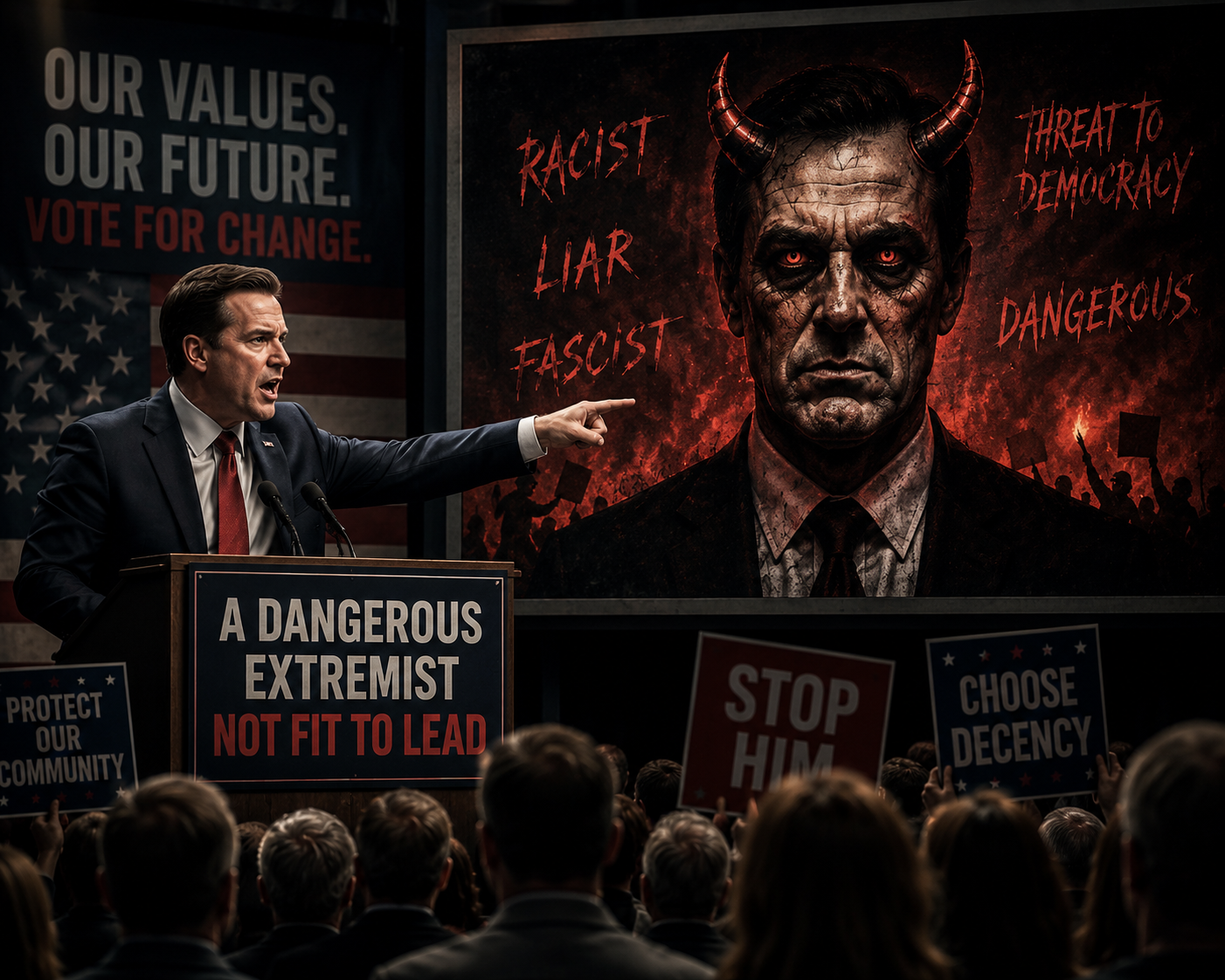
Imagine two political commercials. One is from a candidate who says, “Our markets are hyper-regulated and over-taxed by a government that cares more about feeding itself than about the health and welfare of the people. I’m not running for office to coddle you, or to feed you, but to get the yoke of government off your neck so you have an easier time taking care of yourself.”
The other candidate says, “My opponent is a vile racist who has been accused of rape. He has fascist leanings and he seems to want to kill trans people. He wants to put babies in cages and if elected, he might even try to segregate the population on racial lines and reintroduce Jim Crow. His wife was essentially a prostitute and he is the most vile and evil human being that has ever walked the Earth. He does not deserve your compassion, much less your vote.”
I’m going to go out on a limb and guess that most of the people who read my work are more persuaded by the first candidate’s commercial, but there is a tremendous amount of what statisticians call ‘selection bias’ in that sample.
Richard Lau and colleagues’ major 1999 meta-analysis examined dozens of studies of negative political advertising. It found that negative advertisements were better remembered and generated greater knowledge about campaigns. Lau, Sigelman, and Rovner’s updated 2007 meta-analysis reached a similar conclusion. Negative campaigning can affect attitudes and reduce trust or political efficacy.
We can also combine the two types of commercials into a hybrid, such as the following:
“Hi. I’m Chuck Nubert and I’m running for mayor. You may know my opponent, Dave Laffery. As a business owner, he was accused of racial bias. He is running on closed borders, which in my book makes him a white supremacist. He endorses policies that could be used to take food away from babies, and has a hyper capitalist mindset that I would call ‘fascist’. He is a fascist, in my opinion. Me? I’m all for you. I want every family to get three squares. I will make sure everyone has a home, will provide for the healthcare of everyone in our community, and will open our borders to be welcoming and inclusive. We don’t care who you are or what you look like. You belong here, and NOBODY in our city will be without housing, healthcare, food, or comfort. I am about all things for all people, whereas Mr. Laffery is only about himself and those who look like him. This November, let’s send a clear message to the white supremacists that our city says no!.”
That message appears to do both, and it is particularly clever because it promises to give people things without saying how it will do so. Chuck Nubert never says he will raise taxes. He never says that someone else must surrender a portion of their income so that these promises can be kept, and if pressed he will simply say, “the billionaire class,” or “the rich” will pay for it. He never says that government bureaucrats will decide who receives housing, healthcare, or food, or what those benefits will cost. He simply promises that everyone will receive everything. He even extends the promise to anyone who wishes to join the community, as if he is offering to end scarcity for the world.
He also attacks his political opponent in ways that imply horrific things about him, while using carefully crafted language to avoid being sued.
If everyone deserves the things Nubert promises, why do they not already have them? There are only two possible answers. Either Nubert’s promises are more difficult to fulfill than he has acknowledged, or someone is preventing his promises from being delivered.
Pointing out the first possibility requires explaining scarcity, incentives, taxation, debt, opportunity costs, and the limits of government power, as well as acknowledging that every dollar the government spends must first be taken from someone else or borrowed from future generations. Those are complicated conversations, and complicated conversations rarely fit into thirty-second commercials.
As Ronald Reagan said, “If you are explaining, you’re losing.”
The second explanation is far more politically attractive. If the promises are good, and they are achievable, then the reason people still struggle must be because someone is standing in the way. The villain can change with the audience. It may be billionaires, or it may be corporations. It may be the wealthy, landlords, banks, colonialists, white people, men, Christians, Jews, or some other group perceived to possess power. The important thing is not the identity of the villain but the existence of one.
The promises become believable only if someone can be blamed for preventing their fulfillment.
This is an old pattern. In the French Revolution, the aristocracy and clergy were blamed for the suffering of ordinary Frenchmen. Some criticisms were well-founded, but the search for enemies escalated into the Reign of Terror. In the Bolshevik Revolution, Lenin and later Stalin portrayed the kulaks, bourgeoisie, and “class enemies” as responsible for poverty and inequality.
Hitler blamed Germany’s humiliation, inflation, unemployment, and national decline on Jews, communists, and other supposed internal enemies. Mao blamed landlords, intellectuals, teachers, and “capitalist roaders,” depicting them all as obstacles to equality and revolutionary purity.
Hutu extremists in Rwanda portrayed the Tutsi minority as existential enemies responsible for the nation’s problems. As with the Jews in Nazi Germany, dehumanization preceded genocide.
Cambodia under the Khmer Rouge blamed professionals and educated people. Even those who wore glasses became symbols of exploitation and corruption.
You read that correctly. The Khmer Rouge blamed people with bad eyesight for oppression based on the likelihood that glasses might make them look smart. That’s not as crazy as it sounds either – it is the logical extension of identity politics.
Nor is it always governments who do this. Osama bin Laden argued that Muslim suffering was the fault of America, Jews, secular governments, and their local collaborators. Violence against those groups became a moral obligation.
Once politics becomes a search for villains rather than solutions, demonization becomes necessary. The opponent cannot simply be wrong about tax rates or immigration policy, as that provides no moral justification for treating opponents as obstacles to justice. Opponents need to be portrayed as selfish, hateful, corrupt, or evil. Motives in this context become more important than arguments, and arguments quickly become seen as a waste of time.
This is why modern political campaigns increasingly resemble morality plays rather than debates. One candidate presents himself as the champion of the oppressed while identifying a class of oppressors responsible for society’s failures. The other is not just someone with different ideas, but someone whose continued existence in public life is an injustice.
This is a powerful form of persuasion that appeals to two separate, deeply rooted human needs. The first is the desire to believe that our hardships are not ultimately our responsibility, and the second is the desire to see ourselves as righteous people standing against evil. When those two desires are fused together, politics ceases to be a disagreement over the proper role of government and becomes a struggle between the virtuous and the wicked.
“Your lot in life is not your fault, and I can help you get even with those whose fault it is,” is the oldest lie ever told. A version of this is what the serpent told Eve, what Osama bin Laden used to recruit terrorists, and what Democrats increasingly use as a political platform today. It is the language of Cain against Abel, and it should be no surprise that this rhetoric increasingly leads to violence. If someone believes Trump to be as bad as Hitler, or believes Charlie Kirk really did want to kill trans people, they are also apt to believe violence against such people is justified – and we see in polling that many Americans do believe violence is justified.
An April 2025 study by the Network Contagion Research Institute and Rutgers University found that 55% of respondents identifying as left of center believed the murder of Donald Trump would be at least somewhat justified. Nearly 49% said the same of Elon Musk.
That’s not to demonize Democrats. Republicans would likely use this technique too if they could, but the nature of American conservatism makes it difficult, as we cannot offer ‘free’ in a market economy and it is the promise of ‘free,’ and the notion that ‘free’ does not exist because of oppression, that makes this level of demonization possible. All Republicans can do is kind of a demonization-lite, such as Trump calling a reporter stupid.
That’s not to say Republicans don’t demonize. Of course they do – I’m watching Republicans demonize one another in the Michigan Governor’s primary every day. Republicans, however, have to do so in different ways, as the inability to promise ‘free’ takes the technique Democrats use off the table, and makes Republican demonization less effective.
What I will demonize Democrats on is dishonesty regarding political violence. According to an Anti-Defamation League (ADL) study on extremist political killings between 2013 and 2024, 75.5% of all of them were committed by someone on the political right, vs just 3.4% on the political left.
This study had two major problems. First, the ADL did not classify killings based on the motive for the murder. It classified perpetrators according to what it considered their broader “extremist connections,” then assigned the deaths to an ideological category even when that ideology had little or nothing to do with the killing. The ADL expressly says it tracks murders involving extremists “regardless of motive,” including domestic violence, drug-related crime, organized crime, personal disputes, and confrontations with police.
Second, the ADL played fast and loose with what it considered ‘right-wing’ vs ‘left-wing’ extremism, deciding for itself what beliefs, associations, tattoos, online posts, gang memberships, or prior affiliations were sufficient to classify someone as being ‘extreme’.
Based on the ADL’s methodology, Charlie Kirk’s assassination would have been lumped into right-wing extremism based on reports (later shown to be false) that the killer was right-wing, and Luigi Mangione would not be considered an extremist, so his killing would not be counted at all. Nor was any of the left-wing violence that led to death, related to the George Floyd riots, included, as the rioters were not considered extremists.
The methodology of this ‘study’ was structured in a way guaranteed to inflate one category while excluding other politically charged violence, using what I call the Garb of Science. Nobody should ever cite that ‘study’ as it is pure political propaganda.
The left plays fast and loose with the word ‘science,’ and it plays fast and loose with other words as well. Once the War on Words changed the definition of the word ‘racism’ to ‘power + prejudice,’ with subconscious prejudice being assumed as universal, ‘racism’ was reduced to just ‘power,’ and since white people are assumed to be in power, this meant racism=white.
This transition led to the belief that white people are inherently racist, and that it is impossible for anyone else to be. Throw in the oppressed/oppressor narrative and the notion of the United States as being supposedly built on white supremacy, and suddenly anyone not white is invited to believe they are oppressed. Add into the mix the notion that horrific acts done by the oppressed are really just the oppressed acting out against their oppression (hence not being ‘extremist’ to the ADL), and suddenly those who believe they are oppressed can explore the most vile temptations humans are capable of.
This form of politics does not just demonize people either. It demonizes everything that has come before, holding the current system accountable for the need to pay rent, or to buy food, or to do anything else related to living. This then makes those who defend what came before guilty of denying others everything being promised for free, which is not a political argument so much as a moral condemnation of the past.
This argument cobbles together those who feel oppressed along with those who wish to be the angelic saviors who end that oppression, offering moral goodness devoid of effort. Vote for the right people and you are inducted into sainthood. It also separates intent from effect such that any policy failures that follow can be blamed on political opponents instead of on the policies that caused harm.
Even if it were possible to seize the assets of the rich, that would not cover the costs of everything the left wants to do for more than a few months, which is why every country on Earth that actually supplies those things without going bankrupt takes the money from the poor and middle classes. That is the Scandinavian model – it takes from the poor and middle classes and then supports them with their own money. Also note that the Scandinavian countries are not rich and are not socialist. They flirted with socialism in the 1970s and by 1990 they were forced by economic necessity to revert back to free markets. They kept their generous welfare programs, and are far on par with the poorest US states in per-capita income as a result, even before taking into account their much higher tax rates.
Another problem with this kind of politics is that putting disparate groups together on the pretense of supposed oppression also makes that perceived oppression a political currency. Each group competes to be the most oppressed, as being so also makes it the most powerful. One would think someone might notice that no group can be both powerful and oppressed at the same time, but nobody playing the Oppression Olympics seems to notice this particular absurdity.
This process is also additive. The more a group is believed to be oppressed, the more the enemies of that group are hated within the political mob, and with Islamophobia being now the greatest threat to New York City (according to Mayor Zohran Mamdani), hatred of groups Muslims tend to hate has become politically acceptable.
Qur’an 5:82 depicts Jews as being the most hostile people on Earth; Qur’an 5:60, 2:65, and 7:166 associate Israelites with apes and pigs and call them cursed covenant-breakers. Qur’an 9:29 commands that the People of the Book be fought until they submit and pay tribute. These verses are supplemented with a hadith predicting an apocalyptic Muslim war against the Jews. Islamic scripture and tradition contain unusually severe condemnations of Jews, and modern Islamist movements have repeatedly transformed those passages into political Anti-Semitism.
The 2014 Anti-Defamation League’s Global 100 Survey found that 49% of Muslims worldwide met its threshold for “antisemitic attitudes,” defined as agreeing with at least 6 of 11 Anti-Semitic stereotypes.
Anti-Semitism is vile and disgusting. It needs to stop
If we actually care about the wealth and prosperity of the American people, then the most important statistic is the difference between the rate of inflation and the rate of wage growth. Whenever wages grow faster than inflation, the American worker is becoming wealthier, and whenever inflation runs higher than wage growth, the American worker is becoming more poor. This is a metric that is not based on greed, ideology, resentment, or anything else. It is a simple, objective way to gauge performance.
There are, of course, other objective measurements, but this is one of the few aggregate numbers that starts to look into the health of the economy instead of just its size. Nobody talks about numbers such as this one precisely because they are objective, and nobody wants to be measured that way – Democrat or Republican – and my next book will delve into all of the metrics that look at the health of the economy as I think it is important for people to know how to use metrics to gauge political performance.
Here is another hypothetical campaign commercial:
“Four years ago, you hired my opponent to manage the economy. Since then, wages have grown an average of 3.2 percent per year while inflation has averaged 5.1 percent. That means the average American worker can buy less with an hour of work today than when he took office. Before that, under my administration, wages grew faster than inflation by an average of 1.7 percentage points each year. That meant your paycheck bought more food, more gasoline, more rent, and more opportunity every single year. My opponent says he’s compassionate. I say compassion is measured by results. He says he cares about working families. I say working families should judge him by what happened to their purchasing power while he was in office. He wants to talk about billionaires. I want to talk about your paycheck. He wants to talk about intentions. I want to talk about outcomes. If you think you’re better off today than you were four years ago, vote for him. If you want your wages to grow faster than inflation again, I’d be honored to earn your vote.”
Imagine that. No accusations of racism. No claims that the other candidate secretly hates women, minorities, immigrants, or democracy. No promises to give you things that somebody else must pay for, and best of all, nothing that justifies violence. Just an objective measurement of whether life became better under one administration than another. How about we all agree to vote for people who tell us the policies they support and why they support those policies, without demonizing the other side?
We may question the basis of other people’s morality, of course, but looking at moral codes as systems and then gauging what different moral systems are designed to produce – that’s honest. That’s the hard work of trying to be correct.
That is how politics ought to work. Candidates should compete on performance rather than sanctimony, and on measurable outcomes rather than theater. If politicians believe their ideas produce prosperity, let them prove it with numbers. If they believe their opponents’ ideas produce suffering, let them prove that the same way.
Free people should not have to choose between competing stories about who is good and who is evil. None of us are the Second Coming of Christ, and none of us are the Antichrist. We are all somewhere in between.
We should be choosing between competing records of what actually works.