When you post something to Facebook, algorithms decide where to place it on your friends’ feeds, as well as on the feeds of your friends’ friends. These are the two groups – friends and friends of friends – that make up your personal network.
Some of those in your immediate network may share your post. I call these shares “short-tail shares,” given that your friends’ friends could already see your post, but if your privacy settings allow it, this may open your post to their extended network as well, which moves your post one hop outside your personal network.
Once a post has propagated outside your own network, each share brings it to two new networks of people, and then it has a chance to go viral. I call shares made outside of your personal network “long-tail shares” as neither the friends, nor the friends of friends now seeing it could see it before, and the further from your own network your post goes, the longer its tail gets.
Nor do you see long-tail shares. Facebook recently put me on a ‘professional’ account, so I can see total views, but I had a post recently that, as of my writing this, has over 45,000 views (and growing), and yet it only shows 251 shares. Why? Because I can see the names of those who share my content, and Facebook does not want me to see the names of those who are not part of my immediate network. Those shares stay hidden, leaving only the 251 short-tail shares visible.
Only 2.7% of the viewers were from my personal network, so clearly I had many additional shares.
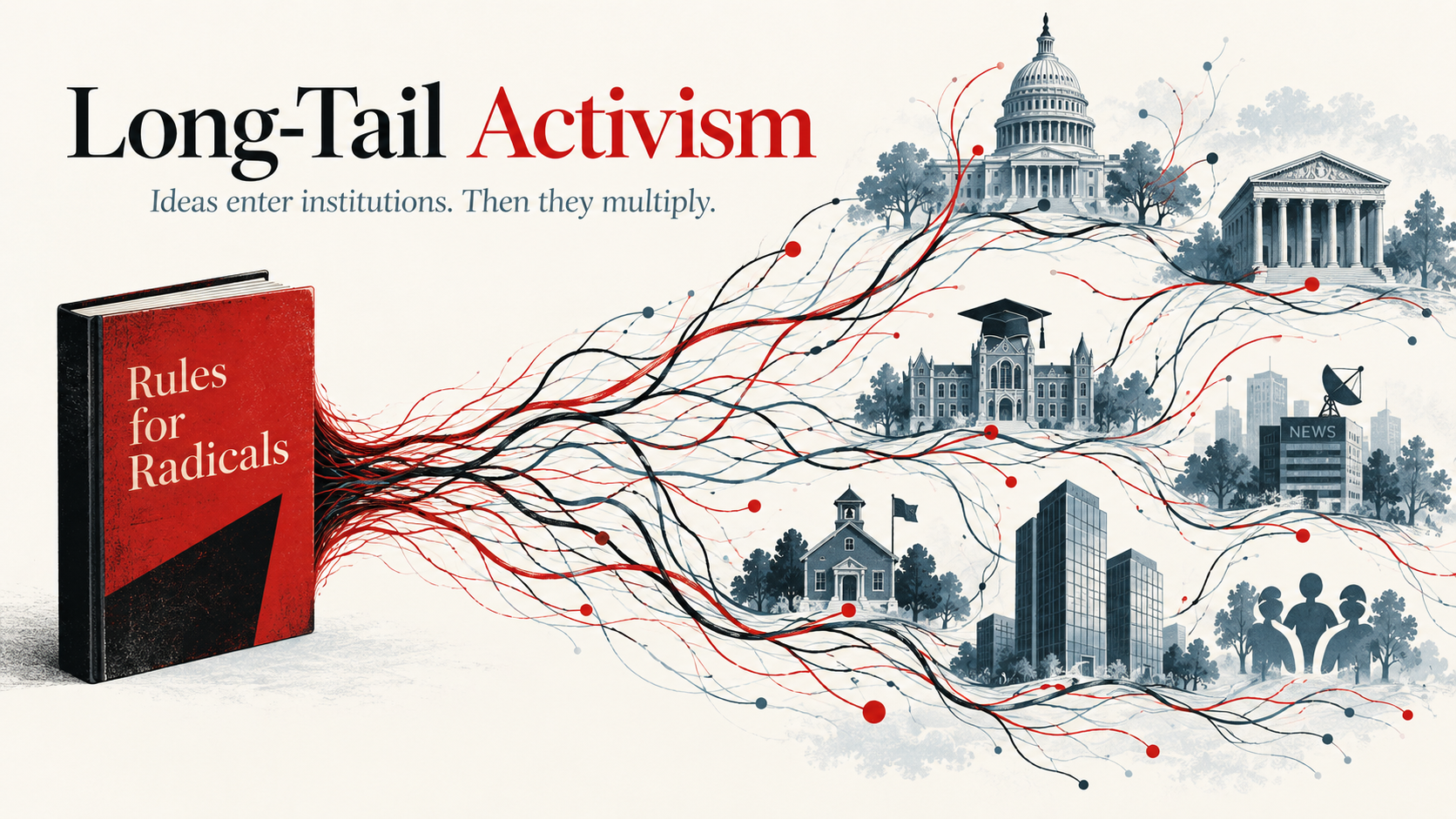
This is the power of the long-tail share, and modern political activism now works in a very similar way.
Most activism throughout history has had a short-tail. Activists organize people, make demands, and protest, with all of the work happening in a circle the activist personally put together. Every new battle requires another act of organization, and someone has to provide the energy, identify the grievance, recruit the people, define the target, and coordinate the pressure, to keep the movement alive.
Long-tail activism is different. It begins when activism moves away from the activist and into our institutions, such as our universities, public-school systems, government agencies, corporate HR departments, professional associations, nonprofits, media organizations, etc., with these institutions then taking over the work of the activists. The institutions begin spreading the activism on their own, making it a part of things like hiring decisions, educational requirements, and corporate compliance, until the views of the activists become part of the ordinary language people use in their everyday lives.
Long-tail activism is the process by which political activism embeds itself into the institutions that are supposed to keep society functioning predictably. Long-tail activism makes those institutions turn against one another, and against the nation as a whole. This is a viral form of activism in which the institutions stop helping to organize and manage society, and instead act to reproduce, enforce, and transmit activist demands far beyond the reach any actual activist could ever hope to reach.
In this essay, I’m going to show you exactly how this process started, and how it works.
I’m not talking about institutional capture, which explains how activists gain influence over an institution. I’m also not talking about bureaucratic entrenchment, which explains why policy becomes difficult to remove.
Long-tail activism describes what happens after the institutions have been captured, and the bureaucrats are already entrenched. At that point, the captured institutions begin to carry the activist’s ideas outward to change or attack all of the other institutions around it with the purpose of either fomenting revolutionary change from within, or of burning the nation down.
Imagine Saul Alinsky’s Rules for Radicals, but instead of being used from outside our institutions (as Alinsky envisioned), imagine those rules embedded within the institutions to change the purpose of the institutions to one of weakening the nation from within.
Building the Machine
The Constitution made political power difficult to concentrate, so none of this was possible with a limited federal government. Congress passed laws, the president executed them, and courts interpreted them. To prevent Congress from passing too many laws, it was split into two, one of which was initially filled by the states rather than by popular vote. The states had far more collective authority for most of our nation’s history than did the federal government.
Woodrow Wilson’s 1887 essay, “The Study of Administration,” argued that modern government needed to be professionally administered, and at the federal rather than the state level. He said that political leaders should set the goals while trained administrators run the country independently of them, such that the mechanizations of power do not change state-to-state or administration-to-administration. Wilson wanted what he saw as a modern bureaucracy of experts to be a permanent, powerful, and immutable entity that would change with the times only as the bureaucrats saw fit.
Wilson understood that a permanent class of professional administrators would begin to see itself as being above the people they governed, but Wilson also believed government had become too complicated to be run by elected officials, and that a ‘moral and intellectual elite’ could run the country far better than those the people might elect.
Elected leaders, according to Wilson, could decide what government should do, but trained administrators who could not be replaced every time there was an election needed to actually run the country. The administrators could take what elected officials wanted into account and decide how to implement those things as policy.
Woodrow Wilson did not envision bureaucrats becoming corrupt and using their positions for personal benefit, and he also did not consider that there could be a great deal of selection bias in terms of who would want to work in that kind of job. Those who believe government should be limited are far less likely to look for work in government, and particularly in the parts of government that do things they do not think government should do. As such, the mechanizations of power tend to lean left, and tend to lean more so over time.
The Pendleton Act was passed in 1883, putting in place a merit-based federal hiring system, and replacing the practice of hiring based on patronage. It also protected federal employees from being fired for political reasons.
Initially, the Pendleton Act protected Republicans, who had dominated the Federal Government going back to Lincoln, but Franklin Delano Roosevelt, under his New Deal, created agencies that were often staffed outside the civil-service system, allowing Roosevelt to hire people who agreed with the Democratic Party and the New Deal. Roosevelt then worked with Congress to create the Ramspeck Act, in 1940 to bring these new administrations into the civil-service system, protecting them from future administrations.
Over time, the federal bureaucracy began to tilt more and more left, and then Lyndon Johnson expanded it even further.
The Great Society did not stop with Medicare, Medicaid, and the War on Poverty. Johnson also started Head Start, the Jobs Corps, HUD, a domestic version of the Peace Corps called VISTA, and a number of other programs, all of which expanded the power of the federal government over the lives of Americans and over the states.
The federal government began taxing the people to pay for things that the federal government had no authority over, including education, highways, health care, welfare, and housing. Washington would then fund those programs for the states, but only if they followed federal rules. In this way, the federal government could dictate to the states even where the federal government lacked authority. The states remained sovereign in law, but they became dependent on federal money and the more money Washington began to fund the states, the harder it became for a state to refuse the attached conditions.
State governments increasingly became administrators of programs designed, funded, and regulated from Washington, all but ending the concept of federalism.
It is easy to envision professional administrators running the country better than elected officials. We have no shortage of people getting elected who either have no idea what they are doing, or who have been captured by ideologies that don’t work. It is tempting to think that professional administrators would be immune to that, but in truth professional administrators are just as fallible as those we elect. Unlike those we elect, we cannot easily remove them.
By the end of the twentieth century, the United States had something the Founders would have rejected, and that Wilson could only have dreamed of: Washington had a permanent professional bureaucracy, enormous regulatory and grantmaking power, federal contracting systems, large enforcement agencies, armies of lawyers, and financial relationships reaching into state governments, universities, corporations, nonprofits, media houses, and almost every other major part of American society.
The machine was in place. All it needed was for someone to figure out how to use it.
Rules for Radicals – Short Tail Activism
Saul Alinsky did not build bureaucracies. He organized people against them. In one scheme, he figured out a loophole in how a chain of private cafeterias operated that essentially let him eat for free.
The loophole was clever. Customers took food and received a paper check showing what they owed. Alinsky ordered only a five-cent cup of coffee and got a five-cent check. He then moved near the cashier, claimed he had lost his check, and because she had seen him drinking only coffee, she charged him another nickel. That allowed him to leave while keeping the original five-cent check.
He then walked to another location, ordered a large meal while sitting where the cashier could not watch him. When he paid, he gave the cashier the five cent ticket and threw the much larger one away.
Alinsky did not just do this himself. He began to encourage others to do the exact same thing. He was outraged that private cafeterias would charge people for food (he told Playboy in an interview that “The right to eat takes precedence over the right to make a profit”), so he tried to get enough people to steal food to drive the chain of cafeterias out of business.
The restaurant chain eventually figured out what was happening and installed machines that issued serialized tickets that were valid only at the restaurant where they were issued. That killed the scheme.
Alinsky joked that his activists had become “victims of automation,” but the process of finding a weakness in a system and organizing people to exploit it stuck with him. Alinsky later called the cafeteria scheme his “first experience as an organizer.” When the cafeterias finally closed the loophole, the students he had organized came back to him and wanted to know what they were going to do next, and what started as a quest for free food became a political movement.
Alinsky went on to organize for the CIO labor union, and in 1939 he helped organize Chicago’s Back of the Yards neighborhood. There he looked for existing groups and institutions, found common grievances, organized people around them, and then looked for pressure points that could force larger institutions to react. Back of the Yards became the model for the Industrial Areas Foundation, which Alinsky founded in 1940 to spread his organizing methods into other communities.
Over the next thirty years, Alinsky refined those methods through campaigns in Chicago and other cities. He learned how to make a relatively small group look powerful, how to force an opponent to react, how to exploit an opponent’s own rules, and how to make resistance more painful than giving in. In 1971, near the end of his life, he collected those lessons in Rules for Radicals.
The cafeteria scam became a political philosophy.
We live in a democracy, but each of us has a very small interest in any given policy, whereas there will always be at least one industry that has a very strong vested interest in any policy. As such, it is easy to organize industries for and against policies, but very hard to organize people. People also tend to move on once a policy becomes law, whereas the industries affected by a law stay very aware of how it becomes regulated over time. As such, the public exerts very little actual power over our institutions.
An organized minority of people, on the other hand, can concentrate its efforts and resources, much more like an industry would, and can have enormous power. Alinsky’s Rules for Radicals created a framework for using that power.
Alinsky’s method was to personify the target and attack them personally with the goal of making refusing it so painful to resist that the institution caves in. Alinsky came up with thirteen rules to inflict pain, listed below.
- Power is not only what you actually have, but what your opponent believes you have.
- Stay within your own people’s experience. If you push them into unfamiliar territory, they become confused and hesitant.
- Push your opponent outside his experience. Make him operate where he is uncomfortable or unprepared.
- Force your opponent to live up to his own stated rules and standards.
- Ridicule is an especially effective weapon because it is difficult to answer.
- A tactic works best when the people carrying it out enjoy doing it.
- A tactic used for too long becomes stale and loses effectiveness.
- Keep applying pressure. Change tactics, but do not let the target recover.
- The threat of an action can be more frightening than the action itself.
- Successful pressure requires sustained operations that keep the opposition reacting.
- If you push a negative hard enough, it can produce a positive result by forcing the opposition into an overreaction or contradiction.
- Every successful attack needs a constructive alternative. If you tear something down, you need an answer for what replaces it.
- Pick a specific target, isolate it, personalize the conflict, and polarize it. Do not attack an abstraction when you can make one person or institution carry the burden of the dispute.
These rules allow relatively small groups to wield tremendous influence. A company, university, or city government might have vastly more money and power than the activists, but it also has far more to lose, and since the attacks are personal, it is not just the institution that can be attacked, but also the specific people in it.
The weakness in the method was the organization required. Every new fight needed people to identify the grievance, rally the community, choose a target, and keep up the pressure. An organizer might force a company to change a hiring policy or pressure a city government into making a concession, but once the campaign ended, the institution continued to operate.
That is what made Alinsky’s activism short-tail. The activist could change what an institution did, but the institution did not take over the activism. The next battle still required another organizer, another campaign, and another round of pressure.
The breakthrough came when activists learned how to remove themselves from the process.
Hillary Rodham and the Problem of Scale
Hillary Rodham spent her senior year at Wellesley studying Saul Alinsky. Her 1969 thesis, There Is Only the Fight…: An Analysis of the Alinsky Model, examined his methods. Alinsky later offered her a job, but she turned him down and went to law school.
Whereas Alinsky believed in exercising pressure on the institutions from without, Hillary Rodham’s thesis suggested that the institutions be taken over and attacked from within. Individual institutions could be taken over by activists, and then used both to further the activism, as well as to attack other institutions if they were not yet on board. The goal was to turn the government, the colleges, the media, and all other institutions against the governing system, and to use the institutions, including the government, either to radically reform our country, or to burn it down and start over.
Rodham’s plan offered a much easier path. Government agencies, universities, courts, corporations, foundations, professional associations, and media organizations all had enormous influence over how the country operated, and how people in the country lived. If these institutions could be filled with activists (what Gramsky called the ‘Long Walk through the Institutions’), the systems Rodham wanted to tear down would do the work for her.
Once activism moved inside the institutions, institutional power spread the ideas for the activists. Universities already taught students, and professional associations already set standards. Licensing boards already controlled who could enter a profession, corporations already set employment rules, and government agencies already wrote regulations. Add in foundations that decided who got money, and suddenly activists could change what those institutions taught, required, funded, or regulated.
The institutions made activism go viral. The activist no longer had to reach people. The institutions put the protests together and let the activists do nothing but lead.
Activism suddenly had a long tail.
Hillary Rodham later met Bill Clinton, and the two became the perfect power couple. Bill supplied the charisma and Hillary supplied the ideas. Bill was not an ideologue though, and as President he did not implement all of Hillary’s ideas, so once his Presidency was over, Hillary Clinton went into the Senate and began to position herself for her own Presidential run.
Most people have no idea how lucky we are that it failed.
Bill Clinton’s National Performance Review was publicly framed as an effort to make government more efficient and less expensive. It did not claim to implement long-tail activism, but it did put in place the architecture.
The old Wilsonian model imagined administration primarily as a hierarchy. Political leaders made decisions from 35,000 feet up, and professional administrators carried them downward through organized bureaucracies to where the rubber meets the road, and though this process is fine in theory, real governments work through interconnected networks of interrelated systems.
Federal agencies deal with state governments, local governments, private contractors, universities, nonprofits, foundations, businesses, advocacy organizations, and professional associations. Programs are delivered through partnerships, and money is passed through grants and contracts, leaving the border between government and civil society far less clear than what Wilson foresaw.
Both parties use networks like this. With conservatives we get contractors, partnerships, grants, think tanks, nonprofits, and private institutions. And there is nothing wrong with that. There are plenty of legitimate reasons for government to work with organizations that possess knowledge or capabilities the government lacks.
The structural consequence is what matters. Government became capable of influencing society through organizations that were not part of the government. That creates reach without clear ownership or accountability.
Hillary Clinton was never able to implement her full strategy, as she lost to Barack Obama in 2008. Barack Obama, however, was a community organizer who had used Saul Alinsky’s methods, and he knew exactly what Hillary Clinton wanted to do. He brought her on board and began to implement her plan for her.
Barack Obama also went to Harvard Law School, and before becoming President he practiced law.
An organizer asks how to create pressure against an institution, a lawyer asks how an institution can be compelled to act, a legislator asks what authority can be written into law, and an executive asks what government can do with authority it already has. Obama operated in all of those worlds.
As president, Obama had tools Wilson could never have imagined. Government could still regulate directly, but it could also use civil rights enforcement, grants, agency guidance, lawsuits, settlements, contracts, and partnerships to shape how other institutions behaved.
Education is a good example. The Department of Education used Title IX guidance to change how schools handled sexual misconduct allegations, removing due-process for the accused. The Departments of Education and Justice later warned schools that discipline policies could create civil rights problems if they produced racial disparities, even if the rules were neutral, leading to an explosion of violence in inner-city schools, where education quickly ground to a halt. Schools across the country were forced to adopt policies that taught to the slowest learners, encouraging them to eliminate standardized testing and advanced curriculum, and the schools were forced to adopt federal educational standards that educated less and propagandized more. Our schools began to create activists.
The same thing happened in housing. HUD used federal housing law and federal funding to influence how local governments dealt with zoning. Washington came up with a market-basket of demographics representing the perfect American average, and demanded that all communities do everything possible to match it. Trump luckily killed that program before it was fully implemented, but had it gone into effect, local governments would have had to use a reverse-redlining program to adopt federal standards for the racial makeup of their communities, or lose all HUD funding.
Washington did not need to make local housing decisions. It only needed to threaten to deny federal funds.
Under short-tail activism, one would have had to send an army of organizers into every school district, university, corporation, and city in the country to accomplish this. Using the institutions to do the activism allowed the administrative state to perform activism on a viral scale.
Manufacturing Organizers
Imagine someone taking a job after an institution has already changed. She does not see the new rules as activism. To her, it’s just how things are done.
The employee handbook already uses the new language. The legal department already works from the new definitions. Employees are trained, and professional groups begin to support the changes in licensing and accreditation systems. Grant requirements enforce the changes.
Employees do not need to read a political manifesto when the institutions they work for teach activist ideas as part of their jobs, and this sort of thing has been going on long enough now that most of our institutions think the activism they are performing is what the institution was created to do.
People learn quickly what gets rewarded, what gets punished, what language is expected, what subjects create trouble, and, perhaps most importantly, what gets people promoted. Most employees are not trying to become activists, but all employees try to succeed in the organizations they work for. Because of this, an institution can become ideological even when most of the people inside it do not think of themselves as ideologues.
Systems matter. Change how an organization hires, trains, evaluates, promotes, defines risk, and measures success, and it will begin selecting people who fit the culture. Those people then train the next group, and suddenly the institution starts to reproduce.
A new employee may never have heard of Saul Alinsky. It does not matter. She inherits his rules, and this is when activism truly develops a long tail.
Just to be clear, Wilson had a point. The government really does need people who know how to do complicated jobs, and a new president cannot replace everyone in government every four years.
The problem is not professional government employees. The problem begins when career bureaucrats start to see their own mission as more legitimate than the elected government they are supposed to serve.
Wilson understood that danger. He wanted trained administrators who were protected from political patronage, but he still expected them to carry out the policies of the government in power. He did not envision a permanent bureaucracy deciding which elected leaders deserved to be obeyed, and he certainly did not foresee his own party encouraging career bureaucrats to ignore a duly elected President.
Institutions develop cultures, though. Career employees stay while presidents come and go. They train younger employees, write procedures, preserve old decisions, maintain outside relationships, and brief incoming political leaders. They also know how the system works in ways a new political appointee does not.
My dad once told me he was in the Army just long enough to figure out how everything gets done. He did not know he was speaking in lean language, but he was talking about how long it takes to learn the systems of a bureaucracy, and he served four years.
Eventually, the bureaucracy starts to see the elected government as temporary and its own mission as permanent. A president who agrees with the bureaucracy is treated as normal while a president who disagrees with it can be treated as a threat. Resistance can then be called professionalism and leaks can be called public service.
Sometimes those descriptions are fair. Political officials can issue illegal orders, and career employees should not follow them, but there is an obvious difference between refusing an illegal order and resisting a lawful policy when the bureaucracy believes its own judgment is morally superior to the president, and once that line gets blurry, the administrative state becomes a swamp.
Wilson wanted enough insulation to let the government function, but now much of the government functions against the very state it is supposed to be a part of, and that insulation resists political correction.
The NGO Ecosystem
Government bureaucracy is only one part of the long-tail system. The outside network matters at least as much, consisting of what are called Non-Governmental Organizations, or NGOs.
Nonprofits are private organizations, but many work closely with government. Some receive grants or contracts. Others provide services, conduct research, file lawsuits, train people, or advocate for policy changes. Government often works with nonprofits, as they can do useful things the government either cannot do well, or does not want to do directly. Government even creates some of them.
Government does not need a federal employee in every city or neighborhood if it can work through organizations already there. Those organizations work with universities, foundations, businesses, courts, state agencies, and the media. The result is a much larger network than the government could ever build on its own.
People move through that network too. Someone may work for an advocacy group, take a government job, move to a university, and later work for a corporation or nonprofit. As people move, they carry their ideas, relationships, language, and assumptions with them.
People often think of this sort of thing as a conspiracy, but it is not one. A conspiracy requires people to coordinate in secret. A system does not, and these systems coordinate openly.
Courts add another layer to the system.
Activist groups have always used lawsuits to force change. Litigation is part of the American system, and consent decrees can make the results of a lawsuit much harder to reverse. The way it works is that a group sues an agency, city, or other government body, and instead of going through a full trial, the two sides agree to changes. A judge approves the agreement, and those changes can then be enforced by the court.
The activist version of this is called “sue and settle,” and it has been used frequently, particularly in environmental law.
Environmental laws often allow outside groups to sue an agency when it fails to meet a deadline or perform a duty required by Congress. Before filing suit, the group may be required to give the agency notice that it intends to sue. That gives the two sides an opportunity to coordinate before the lawsuit is filed.
In an ordinary lawsuit, the two sides disagree and each tries to win. In sue-and-settle, the agency already wants to take some action. There is no disagreement – the agency often writes the lawsuit itself before choosing an outside group to file it, and then says to the group, “Here – sue me with this.”
Critics call this regulation through litigation, and during the Obama years, congressional investigators accused the EPA of repeatedly settling lawsuits brought by environmental groups, sometimes committing the agency to regulatory deadlines and priorities without states, regulated industries, or other affected parties participating in the negotiations.
Under Trump, EPA Administrator Scott Pruitt issued a directive specifically intended to stop that practice. Among other things, he required the EPA to publish notices of intent to sue, to involve affected states and regulated parties when possible, and to allow public comment on proposed settlements. The EPA ignored that directive and continued using sue-and-settle.
Changing the Environment
The most effective political systems do not need to give everyone direct orders. All they have to do is to change the incentives involved, and people act accordingly.
If the government wants a university to change something, it could pass a law telling the university what to do, but it is easier and far less transparent to change the legal risks the university faces. It can also attach conditions to federal money, change civil rights enforcement, or influence accreditation and professional standards. Other institutions can add pressure of their own.
Nobody has to order the university to change. The university changes because the incentives force it to.
Corporations work the same way. Government can change liability rules, employment law, contracting requirements, or disclosure rules. Advocacy groups can create public pressure, and professional organizations can redefine what counts as accepted practice. Universities then train new managers under the new rules. The corporation adapts and then passes the new expectations down to employees and suppliers. Those suppliers may pass them on again.
One institution influences another, which influences another. Before long, it becomes difficult to say where the policy actually started.
That is why systems thinking matters. Political debate usually asks who is in charge, but the better question is what incentives keep producing the same result even when nobody is directing it.
There comes a point when an institution stops responding to activism and begins doing the activism itself. That is what long-tail activism explains.
Institutions are supposed to have purpose. Universities educate, for example, while hospitals treat patients. Newspapers report information and professional groups set standards. Government agencies carry out the law. In long-tail activism, social transformation becomes part of, or perhaps even replaces the institution’s actual purpose.
A university may begin to see its job as not only educating students, but to also encourage a particular ideology and to encourage students to become activists for it. A corporation may decide that changing social attitudes is just as important as selling products, and a professional association may move beyond competence and ethics to begin requiring agreement on political positions before it will grant a licence or accreditation.
Government agencies can do this sort of thing too, by asking not what the law requires, but what social result they want to produce.
At that point, the only difference between an institution and an activist is the ability to scale. Once activism becomes a part of the institutions, it goes viral.
Viral activism is durable whereas individual activists are not, even when individual activists are put into important jobs. People leave, but an institution’s sense of purpose is very difficult to change.
The Five Stages
Long-tail activism occurred in five stages, and the first stage was administrative capacity. Woodrow Wilson and the Progressives wanted a professional government that could manage a modern society without being pulled in a different direction every time we have an election. The New Deal greatly expanded the administrative state, and the Great Society extended federal influence over the states through funding, regulation, and civil rights enforcement.
The second stage was political leverage. Alinsky focused on people outside the institutions. His question was how a relatively weak group could force a much stronger institution to change. His answer was organization, pressure, and conflict. It worked, but every new campaign needed organizers.
The third stage is scaling activism. Hillary Rodham wrote about transitioning from working against institutions from the outside, to working against them from the inside. Institutions slowly became filled with activists.
The fourth stage was institutional propagation. By the time Obama became president, government was tied into a much larger network of courts, nonprofits, universities, contractors, professional groups, corporations, and state and local governments. Obama understood community organizing, law, and executive government. Under his administration, these different tools began to be used together in ways that orchestrated the activist networks, which by this time included much of the government.
The fifth stage is autonomous activism. This is when the system no longer needs the people who built it, and this is where we are today.
There are many reasons people hate Trump. Some of them are even based on things that are true. He really has cheated on his various wives, for example, and he really did attach his name to a bogus real estate school.
But then, all politicians have baggage.
The real reason Trump is as hated as he is, is that all of the mechanisms of power outside his immediate control see him as an existential threat to their activism – and they see their activism as their true purpose. They hate Trump because he is working to strengthen the nation they are trying to radically transform.
Wilson’s model assumed that government administrators were serving a shared national purpose. Whatever his many flaws, including his terrible views on race, he did not imagine a permanent bureaucracy whose job was to undermine the country it served. His administrators were supposed to carry out government policy efficiently. They were not supposed to decide that the country itself was the problem.
Modern progressivism increasingly treats institutions and traditions as things that must be changed. American history is often examined through race, sex, class, colonialism, power, and oppression. No serious history of the United States can ignore slavery, segregation, discrimination, or other abuses of power, but the problem comes when those failures stop being part of the story and become the whole thing.
There is a difference between teaching students about injustice in American history and teaching them that injustice is what defines America, or between fighting actual discrimination, and assuming that every unequal result must come from discrimination. There is also a difference between teaching people to treat one another fairly, and sorting them into moral categories based on race, sex, or other group identities, to then all be treated differently. Our institutions have created a great many ‘woke’ people who have the ability to see oppression where it does not exist.
Once activist ideas became part of the mission of our institutions, the same machinery Wilson wanted to use to administer the country was suddenly being used to reshape the country instead.
Why Elections Stopped Working
Long-tail activism helps explain something that has frustrated conservatives for decades: when Republicans win elections and take control of government, nothing changes.
Some of that is by design. The American system was built to prevent sudden change.
But a new president inherits far more than laws. Today, he inherits the people, regulations, legal interpretations, contracts, grants, court settlements, internal procedures, and outside relationships created by earlier administrations, and if those groups don’t agree with the President they may work against him. That means winning control of the government does not necessarily mean gaining control over how the government actually works.
Republicans often arrive in Washington ready to change policies when the deeper problem is the system producing those policies. Sometimes they fail because the politicians are weak, but usually they fail because they are fighting the wrong thing.
Republicans eventually started to wake up, which is why the Heritage Foundation’s Project 2025 included having the President retake control over every aspect of the Executive Branch, including agencies that had long since become quasi-independent. That means tracing the connections between government agencies and the institutions around them. Grants, regulations, court settlements, professional standards, accreditation, contracting rules, training programs, and personnel networks all help determine how institutions behave.
The goal should not be to find progressives and replace them with conservatives. That would simply reverse the direction of the same system. The goal should be to find places where political choices have been buried inside supposedly neutral rules.
Civil service reform is part of that. Government needs professional employees who know how to do difficult jobs, but those employees still work for an executive branch led by elected officials. Career protection should not give bureaucrats an independent political mandate.
Congress also needs to take back more responsibility. It has spent decades passing broad laws and allowing agencies to fill in important details. That gives Congress less responsibility for the results, and gives permanent agencies more power to decide what the law actually means in practice.
Consent decrees and agency settlements deserve the same attention. Settlements are necessary, but current officials should not be able to quietly make major policy choices much harder for future elected governments to reverse.
Federal grants can also be used to push national policy into institutions that are still technically independent. Congress has every right to decide how federal money is spent, but conditions attached to that money should have a clear relationship to what the money is actually for.
Professional standards and accreditation matter for the same reason. They should measure competence. They should not become political loyalty tests disguised as professional requirements.
Most importantly, conservatives should not build their own version of the same machine. If they capture the same machinery, impose conservative ideological tests, fund conservative activists, and make those policies difficult for future voters to change, they have accepted the progressive model. They are no longer arguing for limited government. They are only arguing over who gets to control unlimited government.
That is the larger danger of long-tail activism. The problem is not simply that progressives learned how to use the system and conservatives did not. The problem is that the system moved political power farther and farther away from voters.
That brings us back to the long-tail share.
When I post something on Facebook, I can see the people in my own network who share it. Once the post moves outside that network however, it begins spreading through people I do not know and cannot see. Each new share exposes it to another network, and eventually the original post can travel far beyond anything I could have reached myself.
Long-tail activism works the same way.
An activist changes a government agency. That agency changes the rules faced by a university. The university trains the people who later run corporations, nonprofits, professional associations, and government agencies. Those institutions then change the rules faced by still more institutions.
The people involved may not know where the ideas started. They may not even think of themselves as activists. They may simply believe they are following the law, meeting professional standards, protecting their organization, and doing their jobs.
Saul Alinsky needed organizers for every new fight. Long-tail activism solved that problem by putting the activism into institutions that already had enormous reach. Once those institutions began spreading the ideas themselves, the activists no longer had to.
Winning elections alone cannot fix this problem. Conservatives have already destroyed the funding mechanisms by taking down USAID. Now we have to restore the proper purpose of the actual institutions, and that may mean tearing some of them down and starting over.
A long-tail share becomes powerful when it leaves the person who created it and begins spreading on its own. Long-tail activism becomes powerful exactly the same way.
The activist eventually disappears. The activism does not.